
If your warehouse is still holding large volumes of traditional silicon-based chargers, 2026 may be the last clear-out window. GaN chargers’ share of new fast-charging kit shipments in China has climbed from less than 10% in 2022 to an estimated 30%–40% in 2026. The global GaN charger market is valued at roughly **US$1.2 billion** in 2026 and is projected to expand to US$6 billion by 2033 at a 25.7% CAGR.
For agents and distributors, this is not just a technology trend—it directly determines your purchasing list and profit structure. Understanding the full evolution from universal chargers to GaN is the only way to judge what to stock next.
1. Four Iterations, Three Eliminations: The “Species Evolution” of Chargers
1.0 Era: Universal Battery Chargers (2003–2007)—A Category Killed by Battery Design
In 2003, the universal battery charger invented by Chen Tianhan, a high school student from Henan, China, officially launched and quickly became a must-have accessory. Its principle was simple: remove the phone battery, clamp two adjustable metal probes onto the positive and negative terminals, and charge directly. It did not care about brand or size. The first batch of hundreds of thousands of units sold out in just a few days.
But the golden age of the universal charger lasted only four years. In 2007, Apple pushed the non-removable battery design, and phone makers followed. Batteries could no longer be removed from the body, destroying the universal charger’s use case. At the same time, most universal chargers delivered under 5W, could not intelligently identify battery parameters, and were prone to overcharging, swelling, and even explosions. Safety flaws accelerated their exit.
Wholesaler lesson: Universal chargers did not die because they were “bad chargers.” They died because phone makers redefined the battery format. Likewise, if you only stock chargers with a single protocol today, your inventory can become dead stock the moment fast-charging standards shift again.
2.0 Era: Silicon-Based Switching Chargers (2007–2018)—A Seesaw Between Size and Power
After universal chargers faded, chargers returned to the “plug-and-cable” route. Early linear chargers stepped down voltage through transformers, resulting in large size and high heat. Then silicon-based switching chargers arrived, converting AC into 50kHz high-frequency AC before stepping down, achieving higher efficiency and smaller size.
But silicon has physical limits. Once switching frequency exceeds roughly 100kHz, conversion efficiency drops sharply. This meant the higher the charger power, the larger the size and the worse the heat. When OPPO launched 20W VOOC flash charging in 2014, the charger was already a noticeable “brick.” By 2018, 65W silicon chargers had reached the edge of consumer tolerance for size and heat.
3.0 Era: GaN Chargers (2018–Present)—A Power Density Revolution
In 2018, Anker launched the world’s first 30W GaN charger for consumer electronics, marking GaN’s official entry into the consumer fast-charging market. In 2019, OPPO released China’s first 65W GaN charger, with a measured volume of only 63.97cm³ and a power density of 1.02W/cm³.
GaN’s physical advantages make this revolution irreversible: its bandgap is about 3 times that of silicon, its breakdown electric field is 10 times higher, and its on-resistance is about 1,000 times lower than silicon devices. GaN chargers reduce volume by 30%–60% and weight by 20%–40% compared with traditional silicon chargers at the same power, while conversion efficiency reaches 93%–95%, versus only 85%–90% for silicon.
This is not a minor innovation. It is a generational leap at the material level.
4.0 Era: 240W PD 3.1 + GaN—The Power Ceiling Is Fully Opened
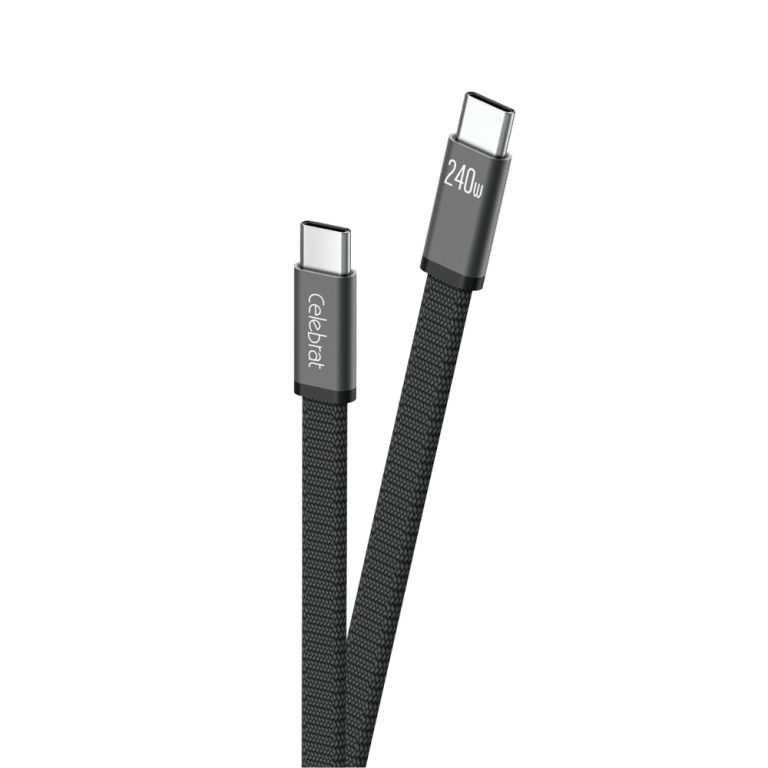
In 2021, USB-IF released the PD 3.1 specification, adding 28V/36V/48V extended voltage tiers and raising USB-C power delivery from 100W to 240W—enough to drive high-performance laptops, monitors, and even some industrial devices.
Combined with GaN, high-power chargers have shrunk to a surprising degree. The Xiaomi 90W GaN charger released in 2025 measures only 34×45×34mm and weighs 65g—about half the volume and one-third the weight of a typical GaN charger. A 240W GaN charger reaches 98.5% energy conversion efficiency and reduces volume by 60% compared with traditional silicon.
On the phone side, fast-charging power is also accelerating. From early 5W slow charging to the widespread adoption of 65W and 120W, and now to 240W flash-charging solutions entering mass production—using a 4,600mAh battery as an example, it can charge from 1% to 21% in 80 seconds and reach full charge in about 9 minutes. 120W to 200W super-fast charging has moved from flagship-only to mid-range standard, forcing procurement structures for chargers and cables to adjust.
2. What Wholesalers Should Focus on in 2026
Price Anchors
Reference FOB Shenzhen wholesale prices for GaN chargers in 2026:
| Power Range | Typical FOB Unit Price | Suggested Retail Price |
|---|---|---|
| 30W single-port | $4.00–$5.50 | $15–$22 |
| 65W dual-port | $7.00–$9.00 | $25–$38 |
| 140W dual-port (with retractable cable) | $15.00–$19.00 | $50–$70 |
By power, a quality GaN charger with full certification typically wholesales at around $0.25–$0.32/W. If the price is far below that range, the supplier has likely compromised on the GaN chip or capacitors.
Power Structure Is Stratifying
18W–30W remains the main volume-driving entry range, but the 66W+ high-power segment has shifted from “optional” to “essential.” Wholesalers need to judge based on target-market device structure: if you serve mid-range Android users, a 65W GaN multi-port charger is a safe choice; if you target laptop users or high-end Android flagship users, 100W–140W PD 3.1 models offer more profit room.
By compliance, starting April 28, 2026, the EU has mandated USB-C PD charging ports for all newly sold laptops. For agents targeting Europe, PD 3.1/PPS support should be a hard SKU entry standard—fixed-voltage chargers will not be compatible with flagship phone fast-charging protocols by 2027.
3. Finding a Supplier for Long-Term Partnership
A wholesaler’s profit margin depends heavily on whether the supplier understands the B2B business. Take CELEBRAT as an example—backed by Guangzhou Yichen Electronics, founded in 1998, with 27 years focused on B2B wholesale, products exported to more than 150 countries, 200+ new products launched annually, and four product lines covering audio, charging, protection, and smart wearables. You can explore its CELEBRAT’s product lines and learn more via the CELEBRAT’s wholesale cooperation page.
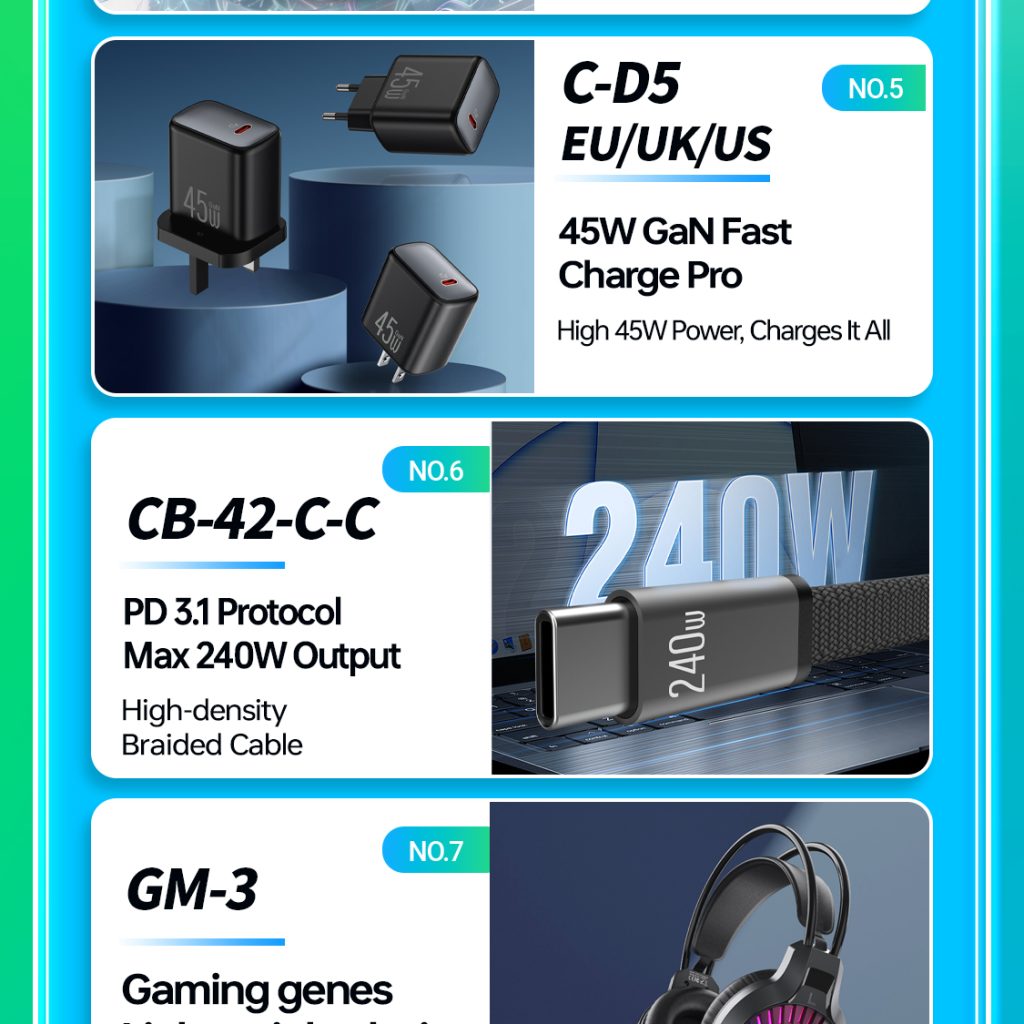
Specifically in the GaN charging category, CELEBRAT’s C-D05 (45W PD GaN USB-C charger, EU plug) supports PD, AFC, FCP, PPS, QC3.0/2.0 multi-protocols, with an intelligent temperature-control chip and five-fold protection against overvoltage, overcharge, overcurrent, short circuit, and overheating. It also has CE-EMC/LVD/RoHS certifications. The travel adapter TC-07 (33W GaN dual USB-C) covers multiple plug standards for different regional markets.
For small and medium-sized distributors placing their first order, CELEBRAT offers flexible tiered MOQ policies and supports low-threshold trial orders. For more product lines and wholesale solutions, visit its CELEBRAT customization.
4. An Easily Overlooked Profit Lever: Customization
Private-label customization (logo printing + custom color box) usually has a lower MOQ threshold than deep tooling customization, making it suitable for agents building local brand recognition. CELEBRAT supports two-tier OEM/ODM solutions, from logo customization to full size/color/tooling customization, and provides digital proof confirmation before mass production. Custom designs are archived under legal protection to ensure IP security.
Practical advice: use samples first to validate local market response, then decide whether to proceed with private label based on sell-through data. Certification for charging products usually takes 4–8 weeks, so planning ahead can prevent peak-season stockouts.
5. Three Bottom Lines for Wholesalers
Bottom line 1: Confirm the GaN chip generation. From Gen1.0 GaNFast to Gen3.0 GaNSense, each generation delivers substantial improvements in voltage withstand, heat dissipation, and EMI performance. Ask suppliers to clearly state which generation of GaN chip they use. Early chips differ significantly in efficiency and thermal control.
Bottom line 2: Ask for proof of PDO negotiation chip. A hard-coded microcontroller cannot renegotiate power when voltage changes, potentially damaging the connected device’s motherboard. This is the key difference between “real PD” and “fake PD.”
Bottom line 3: Check market access certifications. CE/FCC/RoHS are baseline requirements. For the EU market, also pay attention to EN IEC 62680 series compliance.
In 2026’s fast-charging accessory market, technology and compliance thresholds are rising together. From universal chargers to GaN chargers, every technology iteration has eliminated a group of wholesalers who could not keep pace. Choosing the right product line and the right supplier are the two key variables for sustained profitability in this category.