How to Turn a Mobile Accessories Website into a B2B Lead-Generation Tool for Distributors

A B2B lead-generation website is a site built to answer a wholesaler’s five questions fast enough that they ask a sixth — the one that turns into an inquiry. Those questions are: what does this brand sell, is it right for my market, can I trust this supplier, what do I need to compare products, and how do I start a conversation.

Key takeaways

  • Structure the site around buyer tasks, not around the company’s internal org chart. Category, verification, cooperation, and support are four different journeys.
  • Inconsistency between your website and your sales team is a measured problem, not a hypothetical one: 69% of B2B buyers report it.
  • Self-service content is not a substitute for salespeople. 61% of buyers prefer a rep-free experience, but they still want seller input on fit decisions.
  • Every page should end in one clear next action. Pages that end in nothing are the most common leak.
  • Measure qualified inquiries, not form submissions. A rise in submissions with no rise in qualified leads is a symptom, not a result.

What should a B2B accessories website actually contain?

Four functional areas, each answering a different question in the buyer’s sequence:

1. Product discovery. Category pages that explain the category and route to models; product pages with accurate specification, images, packaging detail, available variants, and a visible inquiry action.

2. Company verification. Legal entity, brand ownership, operating history, manufacturing or sourcing footprint, and contact details that resolve to a real place. This area exists to be checked — treat it as a verification document, not a marketing page.

3. Distributor cooperation. What the programme includes, how the application works, what the applicant must provide, and what happens after submission. This is the highest-intent page on the site and usually the thinnest.

4. Support and after-sales. Warranty terms, claim process, documentation, and returns route. Buyers who cannot find this assume the worst, and they assume it before they contact you.

The failure pattern is consistent: sites invest in area 1, treat area 2 as an About Us page, compress area 3 into a form, and skip area 4 entirely.

Why is information consistency a commercial problem?

Because buyers compare what your website says with what your sales team says, and they notice when the two disagree. In Gartner’s 2025 survey of 632 B2B buyers, 69% reported inconsistencies between information on the sales organisation’s website and that provided by sellers.

That finding is about trust rather than tidiness. When a buyer finds a discrepancy — a warranty period, a MOQ, a certification — the natural inference is not “one of these is out of date”. It is “I cannot rely on either”. Gartner’s own commentary on the research frames it as creating mistrust that puts the transaction at risk.

The fix is unglamorous: one approved master record per fact, one owner, and a change process. Specifically, these five must be identical everywhere they appear — website, catalogue, quotation, sales kit, and trade-show material:

  • Legal entity name and brand ownership
  • Launch and operating history
  • Warranty period and scope, by category
  • MOQ and cooperation terms
  • Certification coverage, stated by model or family

Where the sales kit is a separate document, it has to be built from the same master record. That process is covered in what a dealer sales kit should contain.

What self-service material do buyers actually want?

Six items, in the order buyers look for them:

  1. Current product catalogue with a visible revision date
  2. Specification sheets per model, not per category
  3. Warranty terms in writing, by category
  4. Company profile with legal entity and operating history
  5. Distributor programme summary — scope, requirements, process
  6. Certification list by model or family, with issuing body and validity

Two rules about how they are published. First, label the revision date on every file, because an undated catalogue is assumed to be current and will eventually be quoted against. Second, do not gate basic facts behind a form. A buyer who must submit an email address to learn what categories you make will often leave instead — and the ones who do submit are not more qualified, just more persistent.

Gating makes sense for one thing only: material with genuine commercial value to the recipient, such as a price list or a market-specific programme document.

Should buyers be able to complete a purchase without a salesperson?

Partly, and the distinction matters. Gartner’s 2025 research found that 61% of B2B buyers prefer an overall rep-free buying experience, and separately that 73% actively avoid suppliers who send irrelevant outreach.

The two figures are easy to misread as “remove the sales team”. What the same research shows is more specific: buyers prefer self-service for general information and for learning, but they prefer seller input for tasks requiring contextual judgement — such as determining whether a product fits their situation. Gartner’s data puts the average buying journey at roughly 3.0 activities done both online and with reps, 2.3 with reps, and 1.8 through digital self-service.

The operating conclusion: make research frictionless, and make sales contact relevant. Relevance in this category means responding to the buyer’s market, channel, target category, and stated constraint — not sending the same catalogue PDF to every inquiry.

The 73% figure is the one to act on first, because it is entirely within your control. Irrelevant outreach does not just fail; it actively damages the relationship, and it is usually the same templated email sent to a list nobody segmented.

What should the inquiry form ask?

Six fields, and no more. Each one should exist because it changes what you send back.

FieldWhy it is askedWhat it lets you do
Country / marketDetermines everything downstreamRoute to the right pricing and compliance position
Company typeDistributor, importer, retailer, e-commerce sellerDecide which programme applies
Sales channelsRetail, wholesale, online, institutionalJudge fit with your existing channel structure
Product interestAudio, charging, cables, power banks, mixedSend a relevant subset, not the whole catalogue
Estimated annual volumeOrder of magnitude, not precisionSet the tier and the follow-up depth
Current brands carriedReveals positioning and expectationsPrepare a comparison the buyer will find useful

Do not ask for a phone number as a required field. It converts worse and it does not improve lead quality — it just changes how the first contact happens.

The form should also state what happens next. “We reply within two business days with relevant models and programme terms” converts better than a thank-you page, because it converts the buyer’s uncertainty about follow-up.

How should inquiries be followed up?

A fixed five-step sequence, executed the same way every time:

  1. Acknowledge promptly, and reference something specific from the inquiry. A generic acknowledgement is indistinguishable from an auto-reply.
  2. Identify buyer type, market, and channel before sending anything.
  3. Send only the material relevant to those three answers.
  4. Ask one or two qualification questions that the buyer can answer easily.
  5. Record the next action and its date in the CRM.

Then the discipline that separates working follow-up from busy follow-up: if a buyer is not ready, reduce frequency and increase relevance. A useful product update every six weeks outperforms a generic reminder every two weeks — and the Gartner 73% figure is essentially a measurement of what the generic reminder does to the relationship.

Propose a sample or trial-order conversation at the point where the buyer has asked a technical or commercial question, not before. A sample offer made too early reads as pressure.

Which metrics show whether the site is working?

Eight, grouped by what they diagnose:

MetricDiagnoses
Organic sessions to commercial pagesWhether the site is reaching buyers, not browsers
Catalogue downloadsWhether self-service material is discoverable
Inquiry conversion rateWhether pages end in a clear action
Qualified-lead rateWhether the traffic matches the offer
Time to first responseWhether the follow-up process exists
Sample request rateWhether interest is serious
Quotation-to-order conversionWhether the commercial terms work
Repeat inquiry rateWhether the relationship is real

Separate consumer inquiries from wholesale and agency inquiries before drawing any conclusion. In this category, a high submission count is frequently a sign that the site ranks for consumer queries — which looks like success on a dashboard and produces no business.

Where does CELEBRAT’s own site fit?

The same four areas apply, with a specific order of priority: a consistent brand profile, clearly organised audio and charging categories, complete product information, a distributor application page, and B2B content that answers the questions buyers actually ask.

Two content priorities are worth naming because they are usually neglected. First, every article should link to the category page and cooperation page it is relevant to — content that does not route to a commercial page is a cost, not an asset. Second, every product claim, warranty statement, certification reference, and company fact must be checked before publication, because the site is now the master record that the sales team is measured against.

CELEBRAT’s published distributor programme includes material support that shortens this work: product 3D assets, social media content templates, and joint promotion planning. For a distributor building retail-facing content, that is worth evaluating alongside the commercial terms. Confirm the current scope with the brand team.

FAQ

Should every visitor be asked to contact sales?

No. Provide self-service material for research and make contact available when the buyer needs advice or a quotation. Forcing contact too early loses the buyers who are still comparing.

What makes a B2B inquiry qualified?

A real business, a market you can serve, a channel that fits your structure, a product need you can meet, and a plausible purchasing volume or timeline. An inquiry missing two or more of those is a subscriber, not a lead.

How long should a first response take?

Within one business day for a well-formed inquiry, and within two at the outside. Response time is one of the few variables in B2B conversion that is entirely under your control, and it correlates with qualification more strongly than most content improvements.

Should the catalogue be gated?

Gate the price list and market-specific programme documents; leave the catalogue, specifications, warranty terms, and company information open. Gating basic facts reduces volume without improving quality.

How often should website and sales materials be reconciled?

Quarterly, and immediately after any change to price, MOQ, warranty, or certification. Assign one owner for the master record — the failure mode is not a lack of content, it is four versions of the same fact.

Sources

  • Gartner, Gartner Sales Survey Finds 61% of B2B Buyers Prefer a Rep-Free Buying Experience, 25 June 2025 — https://www.gartner.com/en/newsroom/press-releases/2025-06-25-gartner-sales-survey-finds-61-percent-of-b2b-buyers-prefer-a-rep-free-buying-experience. Survey of 632 B2B buyers, fieldwork August–September 2024. Figures cited: 61% prefer an overall rep-free buying experience; 73% actively avoid suppliers who send irrelevant outreach; 69% report inconsistencies between website information and information provided by sellers. Findings cover B2B buying broadly, not mobile accessories specifically.
  • CELEBRAT distributor programme material support as published at https://celebrat.com/about/ — verify current scope before citing in a partner discussion.
  • The page structure, form fields, follow-up sequence, and metric set are operating recommendations, not research findings.
How to Build a Local-Market Product Assortment for a Mobile Accessories Wholesale Business

Product assortment for a mobile accessories wholesale business is the selection of SKUs, price tiers, and product roles that matches what your specific market actually buys — not what the brand’s global catalogue offers. A catalogue can hold hundreds of models; a distributor needs the twenty that keep reordering.

Key takeaways

  • Build the range from local device reality: which connectors, which charging standards, which price points. Fewer assumptions, better hit rate.
  • Every SKU needs a role — traffic driver, repeat purchase, margin contributor, bundle item, or test. A SKU without a role is a SKU without a reason.
  • Segment by price tier and by role at the same time. A 3×5 matrix beats a flat list because it shows you the gaps.
  • Test in small controlled batches with success criteria set before you order, not after.
  • The right moment to expand is when the current range shows repeat demand. New model availability is not a signal.

Why does a global catalogue make a bad local assortment?

Because the variables that determine accessory demand are local. Connector type, charging standard, device price band, replacement cycle, retail format, and even how people charge — at the wall, in the car, from a power bank — differ enough between markets that a range that works in one will under-perform in another.

The reasoning chain that actually connects market data to SKU decisions has four steps, and it is worth walking deliberately because each step is where distributors skip ahead:

  1. Network generation — how much of the installed base is on 4G versus 5G, and how fast is the mix shifting.
  2. Device replacement cycle — how often the base turns over, which sets when new-port accessories are needed.
  3. Accessory replacement frequency — cables and chargers wear out faster than phones are replaced, so accessory demand follows installed base, not new device sales.
  4. SKU structure — which combinations of connector, wattage, and price tier that produces.

Skipping from step 1 to step 4 is how a distributor concludes that a market “needs” a premium fast-charge line because 5G penetration is rising.

GSMA’s Mobile Economy 2025 report offers a useful illustration of why regional differences matter. It estimated that 58% of the world’s population used mobile internet at the end of 2024, and its regional data showed 2024 5G connections at roughly 7% in MENA and 2% in Sub-Saharan Africa, against 55% in North America.

Region5G share of connections (2024)What it implies for accessories
North America~55%Fast-charge, higher-wattage and premium audio carry real volume; USB-C is the default
MENA~7%Mixed base; entry and mid-tier carry volume, premium is a test line
Sub-Saharan Africa~2%4G and legacy connectors dominate; entry-tier charging and durability matter most

Those figures describe connection mix, not accessory demand — they are market context only. But they establish the first link in the chain: a market where 5G is 2% of connections is not a market where a 65W GaN charger is the traffic driver.

How do you segment an assortment by price and role?

Run two dimensions at once. Price tier sets what the customer can afford; role sets what the SKU does for your business. Products that fit neither are the ones that end up aged.

Price tiers: entry (price-sensitive, high rotation, thin margin), core (the dependable volume band), premium (feature and design led, slower rotation, higher margin).

SKU roles: traffic driver, repeat-purchase item, margin contributor, bundle item, seasonal test.

Entry tierCore tierPremium tier
Traffic driverBasic cable, basic wall chargerFast-charge cable, 20W charger—
Repeat purchaseCable multipacksCharger and cable combosReplacement eartips, carry cases
Margin contributor—Branded charging setANC audio, high-capacity power bank
Bundle itemCar charger + cableCharging + audio gift setPremium audio + case
Seasonal testHoliday multipacksBack-to-school combosLimited colourways

The gaps in that matrix are as informative as the entries. A market with no premium traffic driver is normal and correct — premium products rarely drive footfall in this category. A market with an empty repeat-purchase row at every tier is a warning: you have no reason for customers to come back.

The matrix also prevents a specific failure: filling the catalogue with near-identical models that compete for the same customer. Three 20W chargers at the same price point with different mouldings is one product decision made three times, and it triples your ageing-stock exposure for no additional reach.

Which categories should be tested, and in what order?

Audio and charging first, because they carry the highest replacement frequency and the clearest repeat purchase. Cables as the volume base. Power banks where the use case exists. Wearables and car accessories last, and only on evidence.

Category-specific considerations that change the buying decision:

  • Audio — TWS, wired, neckband, over-ear, and speakers occupy different price points and use cases. Do not treat “audio” as one category; a market can support strong TWS volume and near-zero over-ear demand simultaneously.
  • Charging — plug type and supported output are the gate. Confirm local plug standards and whether fast-charge protocols are device-specific in your market.
  • Cables — connector combinations, length, and durability. Cable failure at the strain relief is the single largest returns driver in the category.
  • Power banks — capacity labelling rules, air transport restrictions, and applicable certification. This is the category where a documentation gap stops a shipment.
  • Wearables and car accessories — add only where retailer feedback and market evidence justify it. These are the categories distributors most often add because the brand offers them.

How do you use retailer feedback as evidence?

Ask a small group of retailers in different channel types the same five questions, and record the answers. Feedback becomes evidence when it is specific enough to compare against invoices.

  1. Which products do you sell every week, without prompting?
  2. Which price points move fastest?
  3. What do customers return, and what reason do they give?
  4. Which models do customers ask for that you do not stock?
  5. Which products are difficult to explain at the counter?

Question 5 is the most valuable and the least asked. A product that cannot be explained in fifteen seconds at a retail counter will not sell regardless of its specification — and it usually signals a product-information problem rather than a product problem. That is an editorial fix, covered in quality control and after-sales management.

Cross-check the answers against invoices, repeat orders, and sell-through data. Retailers describe intention; invoices describe behaviour. Where the two disagree, trust the invoice.

How do you run a controlled assortment test?

Set the test up before you order, in writing, with four elements:

  1. A defined test range — small enough to be affordable, broad enough to learn something.
  2. A fixed review period — typically one to two replenishment cycles.
  3. Success criteria stated in numbers — units per week, gross margin, stockout rate, return rate, reorder requests.
  4. A decision rule for each outcome — keep, revise, or discontinue.

Then track it. The disciplines that make the difference:

  • Judge on repeat orders, not first orders. A first order measures the retailer’s optimism; a second order measures the customer.
  • Separate stockout rate from low sales. A SKU that sold poorly because it was unavailable has not been tested.
  • Let the test run its full period. Cutting a test short at the first slow week produces the same conclusion as not testing.
  • Discontinue on the decision rule, not on sentiment. Products that repeatedly miss target are consuming shelf space that a tested performer could use.

Where does a brand range fit into the assortment?

A brand range offers something a loose sourcing list does not: a defined architecture across categories, so the range holds together as a commercial proposition rather than a pile of unrelated SKUs. For CELEBRAT, that means audio and charging as the anchor categories, with cables, power banks, and selected lifestyle accessories around them.

The practical approach for a distributor is to use the brand architecture as the skeleton and the local test as the muscle. Start with the models that match your market’s price bands and connector reality, request the current catalogue, specifications, order quantities, packaging details, and destination-market documentation, and validate suitability locally.

CELEBRAT’s published distributor programme also includes material support that changes the cost of a test — product 3D assets, social media content templates, and joint promotion planning. For a distributor whose constraint is the cost of building retail-facing content, that is worth pricing into the decision rather than treating as a bonus. Confirm the current scope with the brand team.

Stock depth per SKU is a separate decision from range selection, and getting it wrong is what turns a good assortment into aged stock: see how to manage inventory and avoid overstocking. Pricing the resulting range is covered in landed cost and wholesale margin.

FAQ

Should I offer the same products in every country?

No. Device mix, price sensitivity, network generation, plug standards, and regulation vary enough that a single range under-serves most markets. Keep a consistent brand architecture and vary the SKU depth beneath it.

How many models should a new distributor test?

Enough to cover each role in the matrix at the tiers that matter locally, and no more. There is no universal count — the constraint is the cash you can afford to have in stock at once, divided by the number of SKUs you can genuinely support with information and stock.

When should I expand the range?

When the current range shows repeat demand, healthy margin, and low stockout. Expanding in response to a new model launch, a supplier promotion, or a competitor’s catalogue is the most common route to aged stock.

How do I know a product will not sell?

You do not, which is why the test exists. You can, however, recognise the products that are unlikely to: those that cannot be explained at the counter, those with no clear role in the matrix, and those whose price tier has no demonstrated demand in your market.

Does a wider range increase revenue?

Usually it increases inventory and complexity before it increases revenue. Range breadth pays when each addition has a role and a stock depth it can justify. Without that, a wider range simply distributes the same sales across more SKUs and a larger cash commitment.

Sources

How to Manage Mobile Accessories Inventory and Avoid Overstocking as a Distributor

Mobile accessories inventory management is the practice of holding enough stock to fill orders without tying up cash in products that lose relevance as phone models and charging standards change. For a distributor it is a cash-flow problem before it is a warehouse problem: every unit sitting past its selling window is money that cannot be spent on the next order.

Key takeaways

  • Inventory is the largest single use of working capital for most accessories distributors — the goal is the right range at the right depth, not the widest range.
  • Classify every SKU by its commercial role, and re-check that classification monthly. Last quarter’s fast mover is this quarter’s ageing stock.
  • A reorder point is only as reliable as your stock records. Count before you calculate.
  • Slow-moving stock should be dealt with at 60 days, not 120. Compatibility cycles in this category move faster than most distributors plan for.
  • Track three KPIs weekly and four monthly. Seven metrics reviewed together is the same as none.

How should a distributor classify products by sales role?

Sort every SKU into one of four commercial roles, and let the role — not the product category — decide how much stock it carries. The four roles are core fast movers, growth products, campaign or seasonal items, and slow-moving or ageing stock.

The classification has to be reviewed monthly, because it decays. A cable that sold well for two quarters can stop selling the moment a new connector standard reaches your market, and a product does not stay a fast mover just because it used to be one.

Judge each SKU on four signals together, never on volume alone:

SignalWhat it tells youWhere to get it
Sell-through rateWhether retailers are actually moving the unitRetailer sell-out reports or reorder pattern
Gross marginWhether the volume is worth havingLanded cost against wholesale price
Return rateWhether the product creates after-sales costClaims log by model
Repeat-order frequencyWhether demand is durable or one-offInvoice history by customer

A high-volume, low-margin, high-return SKU is not a fast mover. It is a cash drain that looks busy. The four signals together separate the two.

How do you forecast demand when you have little sales history?

Start with 8 to 12 weeks of sales where it exists, calculate average weekly sales per SKU, then adjust for the known events rather than for optimism. New distributors rarely have that history, and the honest answer is that the first two quarters are an experiment, not a forecast.

The adjustments that matter in this category, in rough order of impact:

  • Promotions and campaign periods already agreed with retailers
  • New phone launches in your market — a launch drives cases, screen protection, and cables within weeks
  • Local holidays and pay cycles — accessories are an impulse purchase and follow disposable income closely
  • Confirmed orders not yet shipped, which are demand you already know about
  • Seasonality in your own market, which may not match the brand’s home market at all

Write the assumptions down. A forecast whose assumptions are invisible cannot be reviewed, and an unreviewable forecast is a guess with a spreadsheet around it.

When there is no history at all, buy a trial quantity sized to what you can sell in one replenishment cycle, and collect retailer feedback before scaling. The trial order exists to produce information, not profit.

How do you set a reorder point that actually holds?

The standard formula is a starting point, not an answer:

Reorder Point = Average Daily Demand × Supplier Lead Time + Safety Stock

Worked example: a cable sells 12 units a day, replenishment from the supplier takes 20 days, and you hold 60 units as safety stock. The reorder point is (12 × 20) + 60 = 300 units. This is an illustration of the method, not a target for your market.

The formula is only as good as its weakest input, and in practice that is the stock record itself. Research on inventory record inaccuracy shows that system stock and physical stock diverge, and that the measured size of the gap depends heavily on how the inaccuracy is measured (Glock et al., 2025). The practical consequence is blunt: a reorder point calculated from a stock figure nobody has verified is a number, not a control. Count your top-moving SKUs before you trust the formula on them.

Two inputs deserve more attention than they usually get:

Lead time. Use the supplier’s actual recent performance, not the quoted lead time. If shipment, clearance, and inland transport are part of your replenishment, they belong in the number. Quoted lead time typically covers production only, and the difference between production time and door-to-door time is where most stockouts come from.

Safety stock. Safety stock is not a fixed quantity, it is a buffer against variability. A workable starting method is average daily demand multiplied by the number of days your demand or lead time can realistically swing — longer in promotional periods, before major launches, and during holiday freight congestion. Set it once a quarter, not once a year.

When should slow-moving stock be bundled, discounted, or dropped?

Decide the exit rule before the stock ages, not after. The useful trigger is age bands, and the decision at each band should already be written down:

Stock ageAction
0–30 daysNormal replenishment. No action.
31–60 daysStop replenishing. Push to the retailers who move this category fastest.
61–90 daysBundle with a fast mover, or transfer to a channel with different demand.
Over 90 daysDiscount, liquidate, or claim against the supplier’s replacement terms. Stop buying the SKU.

The reason to move at 60 days rather than 120 is the product lifecycle in this category. Accessories are tied to device generations and charging standards, so a SKU’s commercial life can end for reasons entirely outside your control — a port change, a wattage standard, a shift in what phones ship in the box.

One structural protection is worth checking before you buy: some brand distributor programmes include a replacement or exchange allowance on unsaleable inventory. CELEBRAT’s published distributor programme, for example, states a 15% replacement right for unsaleable inventory alongside free sample support for new products. Confirm the current terms and how “unsaleable” is defined with the brand team before you rely on it in a buy plan — a replacement right is only useful if you know what evidence triggers it.

Which inventory KPIs matter, and how often should you check them?

Split the metrics by cadence, because a dashboard reviewed monthly cannot prevent a stockout that happens in week two.

Weekly — three numbers:

  1. Stockout frequency on your top 20% of SKUs by revenue. This is the metric that most directly costs you sales.
  2. Weeks of cover for those same SKUs — stock on hand divided by average weekly sales.
  3. Open orders against confirmed demand, so you can see a gap forming before it becomes a stockout.

Monthly — four numbers:

  1. Inventory turnover — cost of goods sold divided by average inventory value.
  2. Sell-through rate by SKU and by customer.
  3. Ageing stock share — the percentage of inventory value sitting over 90 days.
  4. Forecast accuracy — actual sales against forecast, by SKU. This is the only metric that tells you whether the process is improving.

No single number is sufficient, and the most misleading one is turnover. A distributor can post excellent turnover while repeatedly stocking out on the three models that carry the business, because the ratio is dominated by the long tail it should be measuring.

What does a monthly inventory review look like?

Run the same review on the same date every month, and keep it to five questions. The value is in the repetition, not the sophistication of the analysis.

  1. Which SKUs made up the top 20% of sales this month, and did that list change from last month?
  2. Which SKUs had falling weekly sales for three consecutive weeks?
  3. For each reorder candidate: what is stock on hand, what is confirmed demand, and what is the lead time?
  4. For each decision: reorder, test, bundle, or discontinue?
  5. What one-page forecast goes to the supplier this month?

That fifth question is the one distributors skip. A short, specific forecast sent to the supplier every month is what turns a transactional relationship into one where the supplier plans capacity for you — and it is usually the difference between getting stock in a shortage and not.

Does inventory management change for a new distributor?

Yes, in one specific way: a new distributor should optimise for information, not for margin. The first two quarters exist to learn which SKUs repeat, which price points move, and which customers reorder without prompting.

That means a deliberately narrow range, a shallow depth per SKU, and a review point fixed in advance. It also means resisting the two mistakes new distributors make most often — buying the full catalogue to look complete, and buying deep on a single model because the unit price was better.

FAQ

How much inventory should a new mobile accessories distributor hold?

Enough to cover one replenishment cycle at realistic sales, and no more. Size the first order to what you can sell and restock within your supplier’s lead time. Cash held back for the second order is worth more than stock bought at a discount on the first.

How often should inventory be reviewed?

Fast movers weekly, the full assortment monthly. The weekly check is about preventing stockouts on the models that carry revenue; the monthly review is about the structure of the range.

Should a distributor stock every product category?

No. Prioritise the categories with demonstrated local demand, prove them with a trial range, then add adjacent categories. Category breadth is a brand’s advantage, not automatically a distributor’s.

Is a higher inventory turnover always better?

No. Turnover improves when you hold less stock, which is also how stockouts happen. Read turnover together with stockout frequency and weeks of cover — a rising turnover combined with rising stockouts means the range is too thin, not that the business is getting more efficient.

What is the single most common inventory mistake?

Trusting the system stock figure. Reorder points, weeks of cover, and ageing reports are all calculated from a number that is only correct if someone has counted. Count the top movers on a schedule and treat the rest as approximate.

Sources

  • Global Payments, Unpacking the Truth about Retail Inventory (2025), survey of 200 retailers — https://www.globalpayments.com/insights/unpacking-the-truth-about-retail-inventory-report. The report covers inventory cash pressure and stock-related customer loss in retail generally; it is not a mobile accessories distributor benchmark.
  • Glock, C. H., Syntetos, A. A., & Rekik, Y. (2025), “On the measurement of inventory record inaccuracies,” The International Review of Retail, Distribution and Consumer Research, 1–28 — https://doi.org/10.1080/09593969.2025.2608729. The paper concerns how record inaccuracy is measured; the reorder-point formula, age-band rules, and review checklist in this article are operating recommendations, not findings reported by the study.
  • CELEBRAT distributor programme terms as published at https://celebrat.com/about/ — verify current replacement rights, sample support, and definitions before relying on them in a buy plan.

CELEBRAT September 2026 Best-Selling Products: Top 10 Picks for Mobile Accessories Wholesalers and Distributors

Introduction: Which CELEBRAT Products Ranked in September 2026?

For mobile accessories wholesalers, distributors, and retailers, choosing the right products is about more than finding competitive prices. Product differentiation, local demand, inventory turnover, and the ability to replenish popular models all influence purchasing decisions.

To help B2B buyers evaluate potential products, CELEBRAT has compiled its September 2026 Top 10 Best-Selling Products, covering wireless audio, charging accessories, and portable power.

The ranking includes TWS earbuds, open-wear stereo (OWS) earbuds, AI translation earbuds, sports headphones, a 240W USB-C cable, a 45W charger, and a 22.5W power bank.

This article introduces all 10 products, explains their potential retail applications, and offers practical suggestions for wholesalers planning their next order.

Ranking note: This is CELEBRAT’s brand-specific September 2026 sales ranking, not a global industry sales ranking. Product suitability and sales performance may vary by market.

1. CELEBRAT September 2026 Top 10 Best-Selling Products

RankModelProduct CategoryKey Selling Point
1W83TWS earbudsCompact design with a leather-texture finish
2W86OWS earbudsComfort-focused, zero-sensation wearing concept
3W90AI translation earbudsAI-assisted wireless translation
4W85TWS earbudsFour microphones with ANC + ENC
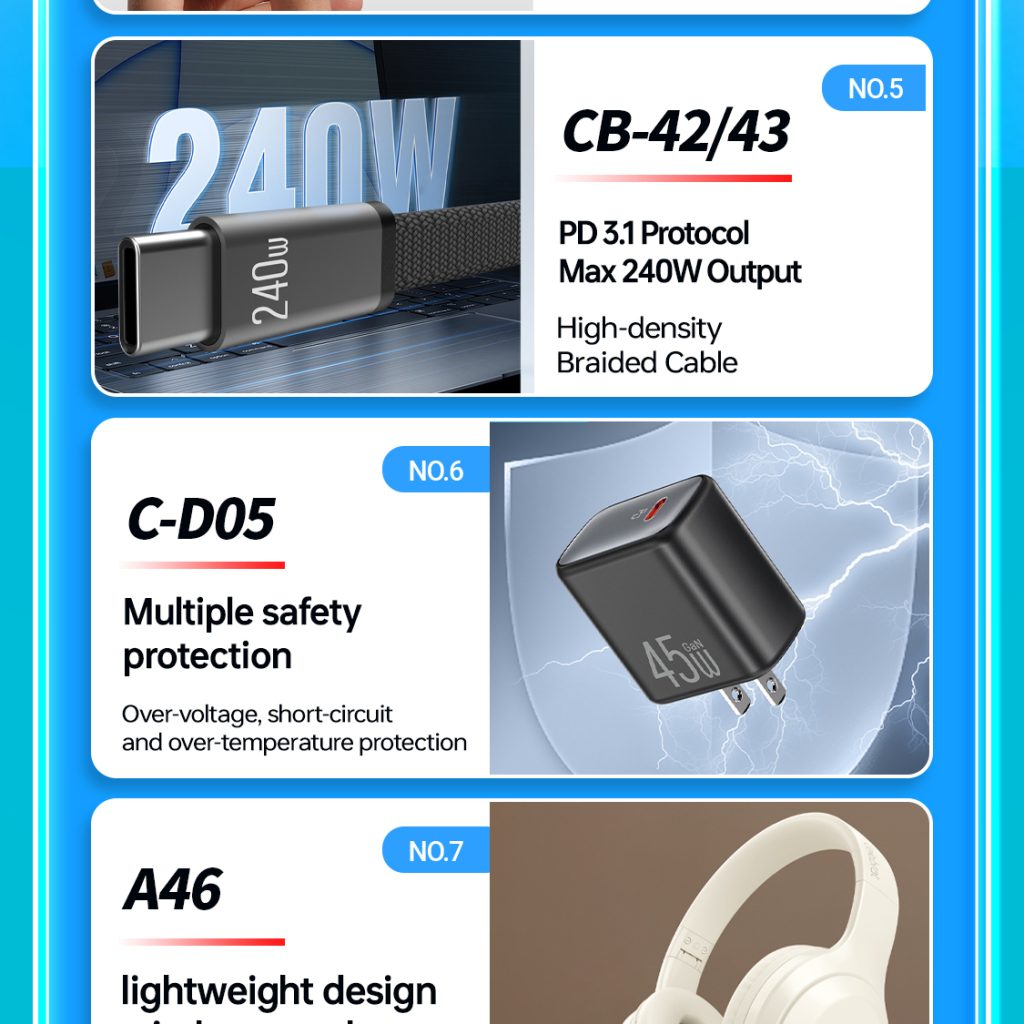
5CB-42240W USB-C cableHigh-power charging, braided cable design
6C-D0545W PD chargerMultiple safety protection features
7A46Over-ear headphonesLightweight design and wireless listening
8SE10Sports neckband headphonesUp to 80 hours of music playback
9SE12Sports neckband headphonesFlexible design for sports and everyday use
10PB-22Power bank22.5W fast charging with a built-in cable

For the full product range, visit the CELEBRAT Product Portfolio.

2. Top 3: Wireless Audio Products Leading the September Ranking

Audio accounts for four of the top five positions in this month’s ranking, highlighting its importance within CELEBRAT’s current product mix.

No. 1 — CELEBRAT W83 TWS Earbuds

Key positioning: Compact wireless audio with a distinctive design

W83 ranks first in CELEBRAT’s September 2026 list. Its compact charging case and leather-texture design give it a more distinctive visual identity than a generic earbud presentation.

For wholesalers, products that combine everyday functionality with recognizable design details can help create more variety across an audio assortment.

Potential sales channels:

  • Mobile accessories retailers
  • Electronics shops
  • Online sellers
  • General wholesalers serving everyday consumer demand

Wholesale tip: Compare the target retail price, packaging, available colors, and expected margin before deciding on the initial order quantity.

No. 2 — CELEBRAT W86 OWS Earbuds

Key positioning: An alternative to conventional in-ear designs

W86 is positioned around a comfort-focused, “zero-sensation wearing” concept. Its open-wear style gives buyers another form factor to consider alongside conventional TWS earbuds.

The product can help wholesalers broaden their audio selection rather than offering only traditional in-ear models.

Potential sales channels:

  • Lifestyle and electronics retailers
  • Online audio accessory stores
  • Sellers targeting consumers interested in alternative wearing styles

Wholesale tip: Demonstrate the wearing style and fit in product images or short videos. Comfort is personal, so avoid promising that every user will experience the same fit.

No. 3 — CELEBRAT W90 AI Translation Earbuds

Key positioning: AI-assisted translation and wireless audio

W90 combines wireless earbuds with AI translation positioning. This gives retailers a more feature-led product story than conventional music-focused earbuds.

Potential audiences include travelers, multilingual users, and customers interested in AI-enabled consumer electronics. Actual translation capabilities depend on the product’s supported languages, software, connectivity, and usage conditions.

Potential sales channels:

  • Travel accessory retailers
  • Electronics and technology stores
  • Online sellers specializing in feature-led products

Wholesale tip: Before promoting W90, confirm supported languages, compatible applications, internet requirements, and any software or service limitations. Clear demonstrations can help buyers understand its value.

3. No. 4–6: TWS Earbuds and Fast-Charging Accessories

No. 4 — CELEBRAT W85 TWS Earbuds

Key positioning: Four microphones with ANC + ENC

W85 features a four-microphone configuration and ANC + ENC noise-reduction positioning.

ANC, or active noise cancellation, is designed to reduce certain ambient sounds for listening. ENC, or environmental noise cancellation, generally refers to technology used to improve voice pickup during calls.

These features provide clear points of comparison when customers evaluate different wireless earbuds. Actual performance depends on implementation and testing conditions.

Wholesale opportunity: Position W85 alongside W83 and W90 to offer different product designs and feature sets within the same audio category.

No. 5 — CELEBRAT CB-42 240W USB-C Cable

Key positioning: High-power charging and a braided cable design

CB-42 is positioned as a high-power USB-C cable supporting up to 240W under compatible conditions.

High-power cables can be relevant to customers who use compatible laptops, tablets, smartphones, and other USB-C devices. However, the maximum power delivered depends on the connected devices, charger, cable specifications, and supported charging protocol.

Wholesale opportunity: Charging cables are a useful complementary category for retailers already selling chargers, power banks, and other mobile accessories.

Wholesale tip: Confirm the exact CB-42 variant, power rating, supported protocol, data-transfer capabilities, and compatibility before listing the product. A 240W rating does not mean every connected device will charge at 240W.

Explore the CELEBRAT data cable category.

No. 6 — CELEBRAT C-D05 45W PD Charger

Key positioning: 45W charging with multiple protection features

C-D05 is positioned as a 45W PD charger with protection features against conditions such as overvoltage, short circuits, and excessive temperature.

For retailers, chargers are a practical companion category to phones, cables, tablets, and other electronic accessories. Offering a suitable range of charging options can help customers complete their purchases in one place.

Wholesale opportunity: Consider pairing chargers with compatible USB-C cables and other charging products to build a more complete charging assortment.

Wholesale tip: Confirm plug type, input voltage, supported output profiles, regional compliance documents, and packaging before placing a bulk order.

4. No. 7–10: Headphones, Sports Audio, and Portable Power

No. 7 — CELEBRAT A46 Over-Ear Headphones

Key positioning: Lightweight wireless headphones

A46 is positioned around lightweight design and wireless listening. Over-ear headphones offer a different wearing experience from compact earbuds and can serve customers who prefer larger earcups for entertainment, commuting, or everyday listening.

Wholesale opportunity: Add A46 to an audio portfolio that already includes TWS earbuds and sports headphones to serve different usage preferences.

No. 8 — CELEBRAT SE10 Sports Neckband Headphones

Key positioning: Up to 80 hours of music playback

SE10 is designed for sports and everyday use, with a neckband structure and a published playback claim of up to 80 hours under specified test conditions.

Its neckband format may appeal to customers who prefer a connected design rather than two fully independent earbuds.

Potential sales channels:

  • Mobile accessories shops
  • Sports and travel accessory retailers
  • General electronics wholesalers

Review the official CELEBRAT SE10 product page for available specifications.

Wholesale tip: When comparing battery-life claims, check the test conditions and volume level. Real-world playback time varies with usage and device settings.

No. 9 — CELEBRAT SE12 Sports Neckband Headphones

Key positioning: Flexible design for sports and daily listening

SE12 is another sports-focused neckband model in the September ranking. Its flexible design and magnetic earbuds, as described in CELEBRAT’s product information, support convenient everyday handling.

For distributors, carrying both SE10 and SE12 may allow comparison of product features, design, and target price points.

Wholesale tip: Avoid assuming that two products in the same category will perform equally in every market. Test customer response and sales velocity before committing to large quantities of both models.

See the CELEBRAT product portfolio for current product details.

No. 10 — CELEBRAT PB-22 22.5W Power Bank

Key positioning: Portable power with a built-in charging cable

PB-22 combines a 22.5W fast-charging position with a built-in cable and dual Type-C port design, according to the September product chart.

The built-in cable can reduce the need to carry a separate cable, while the portable form factor makes the product relevant to commuting, travel, and everyday backup power.

Wholesale opportunity: Power banks complement charging cables, wall chargers, and other mobile accessories, giving retailers opportunities to build convenient charging bundles.

Wholesale tip: Confirm battery capacity, output specifications, supported charging protocols, and applicable battery transport documentation before purchasing or shipping.

5. What Does the September Ranking Tell Mobile Accessories Wholesalers?

The ranking provides a useful snapshot of CELEBRAT’s product mix. It can also help B2B buyers think about portfolio planning.

Trend 1: Audio Is Not One Single Market

The ranking includes conventional TWS earbuds, OWS earbuds, AI translation earbuds, over-ear headphones, and neckband sports headphones.

These products serve different usage scenarios and customer preferences. Instead of stocking many similar models, wholesalers can compare wearing style, key features, target price, and likely customer demand.

External industry data supports the importance of evaluating individual audio segments rather than treating them as identical.

According to Omdia’s September 17, 2026 report, global TWS shipments declined 0.7% year over year to 82.1 million units in the second quarter of 2026. In the same quarter, OWS shipments grew 12% year over year to 11.1 million units.

Omdia also reported that OWS accounted for 13.5% of total TWS shipments in Q2 2026, up from 12.0% a year earlier.

Source: Omdia — OWS Shipments Grow 12% as TWS Market Remains Broadly Flat in Q2 2026.

What this means for wholesalers: Conventional TWS remains an important category, but alternative wearing styles and differentiated features may provide additional product opportunities. Local demand and retail pricing still need to be validated.

Trend 2: AI Features Create New Product Stories

W90 adds AI-assisted translation to the audio portfolio. This reflects a broader direction in which personal audio products are being developed around more specialized use cases.

For distributors, feature-led products can support more informative marketing and product demonstrations. However, claims should be based on verified product capabilities, not general assumptions about AI.

Trend 3: Charging Products Can Complement Audio Sales

CB-42, C-D05, and PB-22 cover a high-power USB-C cable, a 45W charger, and a portable power bank.

These products serve different charging needs and can complement an audio-focused portfolio. A balanced product range may help wholesalers serve more customer requirements without depending entirely on one product category.

6. How Should Distributors and Wholesalers Choose From These 10 Products?

Not every product is suitable for every market. Before placing an order, consider your customers, target price range, competitive landscape, and replenishment requirements.

Buyer typeProducts to evaluate firstPurchasing consideration
General mobile accessories wholesalersW83, W85, CB-42, C-D05Balance everyday audio and charging products
Audio-focused retailersW83, W86, W90, W85, A46Compare wearing styles and feature differentiation
Technology-focused online sellersW90, W85, CB-42Verify product features and build clear product demonstrations
Sports and lifestyle retailersSE10, SE12, W86Evaluate fit, comfort, and use-case suitability
Charging accessory retailersCB-42, C-D05, PB-22Confirm compatibility and complete charging specifications
Regional distributorsA selection across audio and chargingTest demand, manage inventory risk, and plan replenishment

These are suggested evaluation groups, not guaranteed sales recommendations. Actual product selection should be based on local demand, pricing, and trial-order results.

A Simple Three-Step Buying Strategy

Step 1: Shortlist. Select a small group of products that fit your current customers and target price range.

Step 2: Test. Request current specifications, quotations, and samples where appropriate. Verify quality and product claims before making a larger commitment.

Step 3: Replenish based on evidence. Track sell-through, customer feedback, return rates, and gross margin. Reorder products that demonstrate suitable performance in your market.

This approach can help reduce inventory risk while allowing you to explore new product categories.

7. Why Evaluate CELEBRAT for Your Wholesale or Distribution Business?

CELEBRAT is a mobile accessories brand under Guangzhou YISON Electronic Technology Co., Ltd. The parent company entered the electronics accessories industry in 1998, while CELEBRAT was launched in 2017.

The brand’s portfolio includes audio products, charging accessories, smart wearables, and other mobile-related accessories.

For B2B buyers, evaluating a supplier involves more than reviewing a best-seller list. It is also important to understand the full product range, ordering conditions, supply arrangements, and available support.

Explore these official resources:

Potential distributors and wholesalers can contact CELEBRAT directly to confirm current quotations, MOQs, product availability, delivery arrangements, and market-specific cooperation conditions.

Frequently Asked Questions

1. What are CELEBRAT’s top 10 best-selling products for September 2026?

According to CELEBRAT’s September 2026 brand ranking, the top three are W83 TWS earbuds, W86 OWS earbuds, and W90 AI translation earbuds. The list also includes W85, CB-42, C-D05, A46, SE10, SE12, and PB-22.

2. Is this a global ranking of mobile accessories sales?

No. It is CELEBRAT’s brand-specific September 2026 sales ranking, not a ranking of all brands or products worldwide.

3. Which CELEBRAT products should wholesalers consider first?

The answer depends on the target market and customer base. Buyers focused on audio can evaluate the earbud and headphone range, while charging-focused retailers may consider CB-42, C-D05, and PB-22. A small trial order can help validate local demand.

4. Why are OWS earbuds worth evaluating alongside TWS earbuds?

OWS provides an alternative wearing style to conventional in-ear earbuds. Omdia reported 12% year-over-year growth in OWS shipments in Q2 2026, even as overall TWS shipments declined slightly. This indicates that product formats can perform differently within the broader audio category.

5. What should buyers verify before ordering CELEBRAT products in bulk?

Confirm current product specifications, quotations, MOQ, packaging, lead time, warranty terms, and applicable compliance documentation. For products with specific technical claims, verify the exact model and test conditions.

6. How can I become a CELEBRAT distributor?

Visit the official CELEBRAT Distributor Program page to review the available information and contact the brand about eligibility, target markets, order requirements, and cooperation terms.

Conclusion: Use Product Rankings to Make Better Buying Decisions

CELEBRAT’s September 2026 Top 10 ranking covers several mobile accessories categories, from conventional and alternative-style wireless earbuds to AI translation audio, fast-charging accessories, sports headphones, and portable power.

For wholesalers and distributors, the practical takeaway is not simply to order the highest-ranked products. It is to identify which models fit your customers, verify their specifications and commercial terms, test demand where possible, and replenish based on actual sales performance.

To explore the full range, visit the CELEBRAT Product Portfolio or learn more about CELEBRAT distributor cooperation.

Product specifications, availability, pricing, and order terms should be confirmed with CELEBRAT before purchase. Market data cited in this article describes the wider industry and does not establish the global sales ranking of individual CELEBRAT products.

China Sourcing Guide 2026: How International Buyers Can Navigate Trade Shows, Evaluate Suppliers, and Avoid Costly Procurement Mistakes

Introduction: Make Every Trade Show Visit Count

October is one of the busiest months for international sourcing in China. Several major exhibitions bring together manufacturers, trading companies, product developers, and international buyers looking for new products and reliable business partners.

For overseas wholesalers, importers, distributors, retailers, and e-commerce sellers, these exhibitions offer opportunities to compare products, discover emerging trends, negotiate prices, and establish long-term supplier relationships.

However, attending a trade show does not automatically lead to a good purchasing decision. Attractive samples, competitive quotations, and impressive booth displays do not always reflect a supplier’s actual production capabilities, quality control standards, or ability to deliver consistently.

The key is to approach each exhibition with a clear sourcing strategy.

This guide explains the major China sourcing exhibitions in October 2026, how to prepare for a productive visit, how to evaluate suppliers, and how to avoid common procurement mistakes.

1. Major China Sourcing Exhibitions in October 2026

Three major exhibitions are particularly relevant to international buyers seeking consumer electronics, mobile accessories, gifts, household products, and other wholesale merchandise.

1.1 Global Sources Hong Kong Shows

Location: AsiaWorld-Expo, Hong Kong

The Global Sources Hong Kong Shows provide international buyers with opportunities to explore consumer electronics, mobile electronics, lifestyle products, and other export-oriented merchandise.

The October 2026 edition is divided into two phases:

  • Phase 1: October 11–14, 2026
  • Phase 2: October 18–21, 2026

Different product categories are featured across the two phases. Buyers should review the official exhibitor directory and product-category information before deciding which phase to attend.

Who should attend?

  • Mobile accessories wholesalers and distributors
  • Consumer electronics importers
  • Retail chains and e-commerce sellers
  • Buyers looking for new products and OEM/ODM opportunities
  • Businesses seeking to compare multiple suppliers in one trip

For mobile accessories buyers, it is worth comparing audio products, charging accessories, cables, and other electronic accessories while evaluating the suppliers behind them.

1.2 China Import and Export Fair (Canton Fair)

Location: China Import and Export Fair Complex, Guangzhou

The 140th Canton Fair in autumn 2026 is scheduled in three phases:

  • Phase 1: October 15–19, 2026
  • Phase 2: October 23–27, 2026
  • Phase 3: October 31–November 4, 2026

The Canton Fair covers a broad range of industries, making it suitable for buyers who want to explore multiple product categories or develop a more diversified sourcing portfolio.

Who should attend?

  • Importers sourcing products across several categories
  • Distributors developing new product lines
  • Retailers seeking manufacturers and export suppliers
  • Buyers exploring manufacturing, customization, and OEM/ODM options

Because the exhibition is extensive, buyers should identify relevant halls, product categories, and potential suppliers before arrival. Walking through the entire venue without a plan can consume significant time without producing useful leads.

1.3 Shenzhen Gift & Home Products Fair

Location: Shenzhen World Exhibition & Convention Center

The 34th Shenzhen Gift & Home Products Fair is scheduled for October 20–23, 2026.

The exhibition covers gifts, home products, promotional merchandise, and related consumer goods. Its product scope also makes it relevant to buyers exploring mobile electronics and lifestyle accessories.

Who should attend?

  • Gift and promotional product importers
  • Retailers and sourcing companies
  • Buyers developing corporate gift collections
  • Distributors looking for differentiated consumer products
  • Businesses interested in combining electronics with lifestyle merchandise

For buyers who already source mobile accessories, this exhibition may also provide ideas for expanding into complementary categories.

Which Exhibition Should You Choose?

Your sourcing objectiveExhibition to consider
Consumer electronics and mobile accessoriesGlobal Sources Hong Kong Shows
Broad, multi-category sourcingCanton Fair
Gifts, promotional products, and lifestyle merchandiseShenzhen Gift & Home Products Fair
Building a diversified product portfolioCompare relevant categories across multiple exhibitions

The best exhibition depends on your purchasing objectives, product categories, target price range, and supplier requirements. No single exhibition is automatically the best choice for every buyer.

2. Before You Go: Prepare a Clear Sourcing Plan

Successful sourcing begins before you enter the exhibition hall.

2.1 Define Your Target Product Categories

Avoid the temptation to collect samples simply because a product looks attractive.

Instead, divide your purchasing needs into three groups:

  • Core products: Items that already sell consistently in your market.
  • Growth products: Categories with promising demand that you want to develop.
  • Test products: New items you can evaluate through a small initial order.

For mobile accessories wholesalers, a practical starting portfolio may include:

  • TWS wireless earbuds and other audio products
  • Wired earphones and headphones
  • Bluetooth speakers
  • Wall chargers, charging cables, and power banks
  • Smartwatches and other wearable accessories
  • Car mounts and complementary mobile accessories

The right mix depends on local purchasing power, consumer preferences, competing brands, and your existing sales channels.

2.2 Establish Your Target Price and Order Quantity

Before meeting suppliers, define your expected purchase price, initial order quantity, and target retail or wholesale price.

For example, if you plan to introduce a new TWS earbud model, consider:

  • Your target landed cost
  • The minimum order quantity (MOQ)
  • Packaging and customization costs
  • Shipping, insurance, and import duties
  • Local distribution margins
  • Expected selling price and profit margin

A low factory quotation does not necessarily mean a low total procurement cost.

2.3 Prepare a Supplier Questionnaire

Ask every potential supplier the same essential questions so that their answers can be compared objectively.

Evaluation areaQuestions to ask
Company backgroundAre you a manufacturer, trading company, or brand owner?
Product rangeWhich categories do you specialize in?
MOQWhat is the minimum order quantity for each model?
PricingWhat are the prices at different order quantities?
SamplesCan you provide samples for testing?
Quality controlWhat inspections and testing procedures do you use?
CertificationsWhich product-specific certificates and test reports are available?
Lead timeWhat is the standard production lead time?
CustomizationCan you customize packaging, logos, or specifications?
After-sales serviceHow do you handle defective products and warranty claims?
Export experienceWhich markets do you currently serve?

Keep the answers in a spreadsheet or supplier comparison form. This will make post-exhibition decisions much easier.

3. How to Evaluate Chinese Suppliers at a Trade Show

A professional booth and a polished sales presentation can create a positive first impression, but supplier selection requires more than appearance.

3.1 Verify the Company’s Identity and Business Model

First, clarify whether the company is a manufacturer, trading company, brand owner, or a business combining several roles.

Each model can be suitable for different purchasing needs.

A manufacturer may offer more direct production communication and customization options. A trading company may provide broader product selection and consolidated sourcing. A brand owner may offer established product positioning, branded packaging, marketing resources, and a more structured product portfolio.

Rather than assuming one model is always superior, determine which model best matches your business.

Ask for the company’s official website, business information, product catalog, and export references where appropriate. Verify that the company name, quotation, invoice details, and contracting entity are consistent.

3.2 Compare Product Quality, Not Just Appearance

Samples are useful, but visual inspection alone cannot establish product reliability.For electronic accessories, consider testing:

  • Charging and connection performance
  • Audio quality and microphone performance
  • Battery performance under defined test conditions
  • Material quality and assembly consistency
  • Packaging and labeling
  • Compatibility with the intended devices
  • Product-specific safety and regulatory requirements

For larger orders, consider a documented inspection plan and independent testing when appropriate.For battery-powered products, request relevant battery transport documentation where applicable. Confirm that the product meets the regulations required in your destination market rather than relying on a general claim that it is “certified.”

3.3 Assess Production and Delivery Capabilities

Ask how the supplier manages production schedules, raw materials, quality inspections, and peak-season demand.

Useful questions include:

  • What is the normal lead time for a repeat order?
  • How much advance notice is needed for a large order?
  • What happens if a component becomes unavailable?
  • Can the supplier maintain consistent specifications across batches?
  • How are delayed shipments communicated and resolved?

A supplier that communicates clearly about limitations may be a better long-term partner than one that promises everything without providing supporting details.

3.4 Evaluate Long-Term Cooperation Potential

For wholesalers and distributors, supplier selection is not just about a single transaction. It is about whether the partnership can support future growth.

Evaluate whether the supplier can provide:

  • A consistent product portfolio
  • Competitive and transparent wholesale pricing
  • Reasonable MOQs for testing new products
  • Reliable delivery arrangements
  • Product documentation and marketing materials
  • Responsive after-sales support
  • A clear process for handling quality issues

If you intend to build a regional distribution business, ask whether the supplier has a formal distributor program and what requirements apply to market protection, pricing, sales targets, and promotional support.

4. Seven Common Procurement Traps and How to Avoid Them

Trap 1: Choosing a Supplier Based on the Lowest Price

A low quotation can hide differences in materials, specifications, packaging, testing, or after-sales support.

How to avoid it:

Compare quotations on an equivalent basis. Confirm the exact model, technical specifications, packaging, order quantity, delivery terms, and warranty conditions before making a price comparison.

Trap 2: Believing Every Exhibition Sample Represents Mass Production

Samples may be specially prepared and may not fully represent the quality of a future production batch.

How to avoid it:

Approve a reference sample and record the required specifications. For significant orders, agree on quality standards, inspection procedures, and acceptable defect criteria before production.

Trap 3: Ignoring MOQ and Hidden Costs

The advertised price may apply only to a large order. Custom packaging, logo printing, accessories, tooling, and shipping can increase the total cost.

How to avoid it:

Request a written quotation with pricing tiers, MOQ, customization charges, payment terms, packaging details, and delivery conditions. Calculate the landed cost rather than relying solely on the unit price.

Trap 4: Accepting Unsupported Certification Claims

A supplier may mention certifications without confirming whether the documents apply to the exact product, model, manufacturer, or destination market.

How to avoid it:

Request the relevant reports and certificates. Check their validity, scope, issuing organization, and model details. Confirm applicable requirements with your customs broker or compliance specialist.

Trap 5: Placing a Large Order Before Testing Demand

A product may look promising at an exhibition but sell slowly in your local market.

How to avoid it:

Where feasible, start with a sample order or controlled trial quantity. Track sales velocity, customer feedback, return rates, and gross margin before increasing the order size.

Trap 6: Overlooking After-Sales Responsibilities

Unclear warranty terms can create disputes when products arrive defective or fail during use.

How to avoid it:

Clarify the warranty period, evidence requirements, replacement or compensation arrangements, claim deadlines, and responsibility for return shipping. Put agreed terms in writing.

Trap 7: Making a Decision Based on Verbal Promises

Verbal assurances about exclusivity, delivery dates, pricing, or marketing support may be difficult to enforce if they are not reflected in the agreement.

How to avoid it:

Document key commercial terms in the quotation, purchase order, or contract. For distribution arrangements, define territory, sales targets, exclusivity conditions, performance reviews, and termination provisions.

5. A Practical Supplier Evaluation Scorecard

After meeting several suppliers, it is easy to confuse one company’s advantages with another’s. A standardized scorecard helps you make more objective decisions.

Use the following framework to evaluate each supplier on a scale of 1–5, where 1 is poor and 5 is excellent.

Evaluation criterionSuggested weight
Product quality and consistency25%
Price and total procurement cost20%
Product range and innovation15%
Delivery and supply reliability15%
After-sales service10%
Communication and documentation10%
Customization flexibility5%
Total100%

Calculate the weighted score by multiplying each rating by its weight and adding the results.

For example, a supplier with strong product quality, transparent pricing, and reliable delivery may be a better choice than one offering the lowest unit price but providing limited documentation and weak after-sales support.

The weights can be adjusted according to your business model. A small-batch e-commerce seller may prioritize low MOQ and product flexibility, while a regional distributor may place greater emphasis on supply continuity, warranty support, and market development.

Important: A high score is a decision aid, not a substitute for due diligence. Serious concerns about legal identity, product safety, payment security, or contractual terms should be resolved before placing an order.

6. What to Do After the Exhibition

The value of a sourcing trip depends on what happens after the meetings.

Step 1: Organize Supplier Information Within 48 Hours

Record each supplier’s company name, contact details, product categories, quoted prices, MOQ, lead time, sample availability, and next steps.

Separate high-priority suppliers from those requiring further verification.

Step 2: Request Formal Quotations and Samples

Ask shortlisted suppliers to provide written quotations with complete specifications. For products that require performance testing, request samples before committing to a large purchase.

Ensure that samples and quotations refer to the same model and configuration.

Step 3: Compare Total Costs

Include product costs, packaging, inspection, freight, insurance, duties, taxes, and other relevant expenses.

Compare suppliers under the same delivery terms and order quantities wherever possible.

Step 4: Verify the Supplier Before Paying

Check the contracting company’s identity and payment beneficiary. Review the contract, payment schedule, delivery terms, and procedures for resolving disputes.

For larger orders, consider a factory audit, third-party inspection, or other risk-control measures appropriate to the transaction.

Step 5: Start with a Controlled Trial Order

Where commercially feasible, use an initial order to assess product consistency, delivery performance, packaging, and communication.

Use the results to decide whether to increase order volume or expand the product range.

Step 6: Build a Long-Term Supplier Relationship

Once a supplier demonstrates consistent performance, establish a regular process for demand forecasting, product updates, replenishment, quality feedback, and after-sales claims.

A reliable sourcing relationship can reduce repeated supplier-search costs and make inventory planning more predictable.

7. Beyond the Exhibition: How to Find Reliable Mobile Accessories Partners

Trade shows are valuable sourcing channels, but they are not the only way to identify potential suppliers.

International buyers can also use official company websites, online product catalogs, verified business contacts, industry referrals, and direct supplier discussions to build a shortlist.

For mobile accessories wholesalers, choosing a supplier with a coherent product portfolio may simplify procurement. Instead of managing many separate suppliers for every product category, buyers can evaluate whether one qualified partner can supply several complementary product lines while maintaining consistent quality and service.

Why Consider a Brand-Based Sourcing Model?

Working with an established mobile accessories brand may provide benefits beyond product supply, depending on the partnership:

  • A more structured product catalog
  • Consistent brand positioning
  • Product and marketing materials
  • Support for distributor development
  • More coordinated product updates
  • A clearer framework for long-term cooperation

These benefits should be verified with the individual supplier. They are not guaranteed simply because a company owns a brand.

Explore CELEBRAT as a Mobile Accessories Sourcing Option

CELEBRAT is a mobile accessories brand under Guangzhou YISON Electronic Technology Co., Ltd. Its product portfolio covers categories including audio products, charging accessories, smart wearables, and other mobile-related accessories.

For international wholesalers, retailers, and potential distributors who want to evaluate CELEBRAT, the following official resources provide a starting point:

CELEBRAT is sharing this guide as general sourcing information. CELEBRAT is not participating in the October 2026 exhibitions discussed in this article, and this guide does not indicate that the brand has a booth at any of them.

Buyers interested in cooperation can review the official product information and contact the brand directly to discuss product availability, order requirements, and distributor eligibility.

8. Frequently Asked Questions

Q1. Which China trade show is best for mobile accessories buyers in October 2026?

Global Sources Hong Kong Shows is a relevant option for buyers focused on consumer electronics and mobile accessories. The Canton Fair may suit buyers with broader sourcing requirements. Always review the official product categories and exhibitor information before planning your visit.

Q2. How can overseas buyers avoid unreliable Chinese suppliers?

Verify the supplier’s identity, compare complete quotations, test product samples, review relevant compliance documentation, clarify warranty terms, and use written contracts. For larger purchases, consider independent inspections and additional due diligence.

Q3. Is the lowest supplier quotation always the best option?

No. Buyers should compare product specifications, quality, MOQ, packaging, shipping, payment terms, warranty support, and total landed cost. The lowest unit price may not produce the best overall purchasing outcome.

Q4. Should I place a large order immediately after meeting a supplier at an exhibition?

Not necessarily. If you have not previously worked with the supplier, consider sample testing or a controlled trial order. Increase order quantities after confirming product quality, delivery performance, and local market demand.

Q5. What should I ask a mobile accessories supplier before placing an order?

At minimum, confirm the exact model and specifications, unit price, MOQ, lead time, packaging, applicable certifications, payment terms, shipping arrangements, warranty coverage, and procedures for defective products.

Q6. Can I source products without attending a trade show?

Yes. You can identify potential suppliers through official websites, product catalogs, industry referrals, and direct online communication. However, you should still verify the supplier, assess samples where appropriate, and document the commercial terms before ordering.

Q7. How can I find a Chinese mobile accessories brand for distribution?

Start by identifying brands with products suited to your market. Evaluate their portfolio, wholesale terms, supply capabilities, after-sales policies, marketing support, and distributor requirements. Contact the brand directly to discuss territory availability and the conditions for cooperation.

Conclusion: Turn Trade Show Meetings into Better Purchasing Decisions

China’s October sourcing exhibitions provide international buyers with opportunities to discover products, compare suppliers, and develop new business relationships. But the real value comes from selecting partners who can meet your requirements after the exhibition ends.

Prepare your purchasing objectives in advance, evaluate suppliers using consistent criteria, test products before scaling up, and document all important commercial terms. These steps can help reduce procurement risks and create a more sustainable wholesale business.

Whether you source directly at exhibitions or through online channels, focus on three priorities: product quality, total procurement cost, and long-term supplier reliability.

If you are exploring mobile accessories for your wholesale or distribution business, visit the CELEBRAT product portfolio to review available categories, or learn more about CELEBRAT distributor cooperation.

Disclaimer: Exhibition dates and details are based on the organizers’ published information available when this article was prepared. Please check the official exhibition websites for the latest schedules, venue information, registration requirements, and exhibitor lists.

2026 Middle East Phone Accessories Brands Worth Watching: A Selection Guide for Agents and Distributors

The Middle East remains an important market for smartphones, consumer electronics, and phone accessories. For wholesalers, agents, distributors, and retailers, choosing a phone accessories brand is not just about finding a supplier with the lowest purchase price.

A brand partnership that can grow over the long term usually requires a comprehensive evaluation of:

  • Whether the products match local market demand
  • Wholesale pricing and profit margins
  • Whether the product categories are rich enough
  • Supply stability
  • Brand awareness
  • After-sales service
  • Marketing support
  • Regional channel protection
  • New product development capability
  • Whether cooperation can develop from a trial order into a long-term agency relationship

Looking at the broader Middle East and Africa (MEA) smartphone market, the market structure continues to change. Counterpoint Research data shows:

  • In Q1 2025, MEA smartphone shipments grew 7% year over year, with 5G penetration reaching 33%.
  • In Q2 2025, MEA smartphone shipments continued to grow 3% year over year, with 5G penetration reaching 37%. Chinese phone brands accounted for 59% of smartphone shipments in the region.
  • In Q2 2026, MEA smartphone shipments fell 10% year over year, but 5G phone shipments still grew 8% year over year.

This shows that technological upgrading and overall shipment growth do not always move in sync. For phone accessories agents, this means that when choosing a brand, you should not only look at “brand awareness,” but also pay more attention to the fit between products and the market, as well as the fit between the brand and your own business model.

Note: This article is not a ranking by sales revenue or market share. The “5 brands” are organized based on brand awareness, product coverage, channel relevance, and reference value for Middle East market buyers. The purpose is to help agents, distributors, and wholesalers build a brand selection reference.


Table of Contents

  1. Why Are Phone Accessories Brands Becoming More Important in the Middle East?
  2. 5 Phone Accessories Brands Worth Watching in the Middle East in 2026
  3. 8 Key Dimensions for Middle East Agents When Choosing Phone Accessories Brands
  4. What Should Different Types of Middle East Agents Focus On?
  5. CELEBRAT’s Agent Case in the Middle East
  6. Why Is CELEBRAT Worth the Attention of Middle East Agents?
  7. FAQ: Common Questions About Middle East Phone Accessories Brands
  8. Conclusion

Why Are Phone Accessories Brands Becoming More Important in the Middle East?

Demand for phone accessories in the Middle East is closely tied to smartphone shipments, 5G upgrades, consumer segmentation, and channel changes. For Middle East phone accessories agents and wholesalers, a brand that can support long-term cooperation usually needs to meet the following conditions:

  • Products match local market demand
  • Wholesale pricing and profit margins are reasonable
  • Product categories are rich enough to support cross-selling
  • Supply and replenishment are stable
  • The brand has a certain level of awareness
  • After-sales service is clear
  • Marketing support is provided
  • Regional channel protection is available
  • New product development capability is in place
  • Cooperation can develop from a trial order into a long-term agency relationship

From the broader Middle East and Africa (MEA) market perspective, the structure is also continuing to change. Counterpoint Research data shows:

  • In Q1 2025, MEA smartphone shipments grew 7% year over year, with 5G penetration reaching 33%.
  • In Q2 2025, MEA smartphone shipments continued to grow 3% year over year, with 5G penetration reaching 37%. Chinese phone brands accounted for 59% of smartphone shipments in the region.
  • In Q2 2026, MEA smartphone shipments fell 10% year over year, but 5G phone shipments still grew 8% year over year.

This shows that technological upgrading and overall shipment growth do not always move in sync. For phone accessories agents, when choosing a brand, you should not only look at “brand awareness,” but also pay more attention to the fit between products and the market, and the fit between the brand and your own business model.


5 Phone Accessories Brands Worth Watching in the Middle East in 2026

1. Anker

Anker is a globally recognized consumer electronics and charging products brand. Its core products include chargers, power banks, wireless chargers, data cables, charging stations, USB hubs, docking stations, and car chargers. Its business also covers audio and smart home fields.

Suitable channels: Mid-to-high-end retail, e-commerce, brand stores.

2. UGREEN

UGREEN has built a relatively complete product ecosystem around charging, connectivity, and digital accessories. Its current products include chargers, power banks, wireless chargers, USB hubs, docking stations, data cables, audio products, and other digital accessories.

Suitable channels: 3C digital retail, e-commerce, corporate procurement.

3. Baseus

Baseus is one of China’s consumer electronics accessories brands, focusing on charging, connectivity, and lifestyle electronics. Its products include data cables, chargers, power banks, and automotive electronics, among other categories.

Suitable channels: Retail, e-commerce, wholesale.

4. REMAX

REMAX has a relatively rich consumer electronics accessories product system, covering power banks, charging, audio, smart wearables, phone protection, automotive electronics, and other phone peripheral products.

Suitable channels: Wholesale, retail, e-commerce.

5. CELEBRAT

CELEBRAT is a phone accessories brand under Guangzhou Yisen Electronic Technology Co., Ltd. Its parent company entered the phone accessories industry in 1998, and CELEBRAT was launched in 2017. The brand mainly serves the global B2B market, with products covering audio, charging, phone protection, smart wearables, and lifestyle electronics.

Main product categories include:

  • TWS earbuds
  • Bluetooth headphones
  • Wired earphones
  • Bluetooth speakers
  • Chargers
  • Data cables
  • Power banks
  • Smart wearables
  • Car accessories
  • Phone protection products

CELEBRAT official data shows that the brand currently has 20+ product categories, 200+ new products each year, products sold in more than 150 countries and regions, and cooperative relationships with 100+ distributors and partners.

For Middle East phone accessories agents, CELEBRAT is not a brand doing only a single audio product category. Instead, through a multi-category product system, it provides agents with a more complete phone accessories purchasing portfolio.

View CELEBRAT Product Center


8 Key Dimensions for Middle East Agents When Choosing Phone Accessories Brands

Instead of asking “Which phone accessories brand is the best?”, it is better to ask: “Which brand best fits my market, channel, and business model?”

FactorQuestions to Consider
ProductDoes it match local market demand?
PriceIs there enough profit margin in wholesale and retail channels?
MOQCan I start with a trial order?
SupplyAre supply and replenishment stable?
BrandIs there enough brand foundation to support sales?
Channel protectionCan the regional market be protected?
MarketingAre sales and promotion materials provided?
After-salesIs there a clear warranty process?
New productsAre new products launched continuously?
CooperationCan a long-term cooperative relationship be established?

1. Do the Products Fit the Local Market?

Consumer demand varies across Middle East countries and channels. Agents should focus on:

  • Which products are currently selling locally?
  • Which products have repeat purchase demand?
  • Which price ranges sell most easily?
  • Are the products more suitable for offline retail, wholesale, or e-commerce?
  • Can the brand cover different consumer levels?

2. Are the Product Categories Rich Enough?

A hit product can bring sales, but a richer product portfolio can help agents cross-sell.

For example: Audio → Charging → Power Banks → Data Cables → Smart Wearables → Car Accessories.

If a supplier can cover multiple categories, agents can reduce the management cost of dealing with multiple brands and multiple suppliers. This is also one of CELEBRAT’s current product positioning points: its products cover 20+ phone accessories categories.

3. Wholesale Pricing and Profit Margins

Purchase price is only one part of an agent’s profit model. Agents should comprehensively consider:

Purchase cost + logistics cost + marketing cost + after-sales cost + inventory risk + channel cost = total operating cost.

A brand with a slightly higher purchase price may still have commercial value if it offers better product differentiation, higher sales efficiency, or more complete channel support.

4. MOQ and Trial Order Policy

For a new brand just starting cooperation, agents should not build too much inventory at the beginning. A more reasonable process can be:

Sample → Trial order → Market feedback → Replenishment → Category expansion → Long-term channel building.

In this way, you can first determine which products truly fit the local market, and then gradually expand purchase scale.

5. Regional Market Protection

For regional agents, channel conflict can become an important issue in long-term cooperation. Before signing an agency agreement, you should confirm:

  • Is the agency territory clearly defined?
  • Will other agents be developed in the same market?
  • Are online channels included?
  • How are unauthorized distributors handled?
  • Are there annual sales targets?
  • If targets are not met, how is the agency qualification handled?

CELEBRAT’s official agent system currently explicitly mentions regional protection and exclusive agency rights.

Learn About the CELEBRAT Agent Program

6. After-Sales Service

For B2B customers, after-sales service directly affects brand operating costs. Before cooperating, agents should confirm:

  • Product warranty period
  • Defective product handling process
  • Product replacement policy
  • Technical support
  • Accessory support
  • After-sales communication process

When agents begin to build a long-term regional sales network, a clear after-sales system is especially important.

7. Marketing Support

Agents need more than products. They also need:

  • Product images
  • Product videos
  • Social media content
  • Product specifications
  • Posters
  • Store display materials
  • New product launch materials
  • Localized marketing support

CELEBRAT’s official agent program currently provides digital marketing materials, localized marketing support, training, and new product launch support.

8. New Product Development Capability

The Middle East phone accessories market changes quickly. Agents need brands to continuously launch new products to maintain channel vitality and update terminal displays. When evaluating a brand, you can look at its annual new product count, development cycle, whether it supports regional customization, and whether new products are prioritized for agents.


What Should Different Types of Middle East Agents Focus On?

Different agent business models have different requirements for brands.

Mid-to-High-End Market Agents

They may focus more on:

  • International brand awareness
  • High-end product design
  • Advanced charging technology
  • Store display effectiveness

Wholesale Market Agents

They may focus more on:

  • Rich SKUs
  • Competitive wholesale prices
  • Fast-moving products
  • Flexible purchasing
  • Stable supply

E-Commerce Agents

They may focus more on:

  • Product differentiation
  • Product visual content
  • New product frequency
  • Search demand
  • Logistics-friendly products

Regional Exclusive Agents

They may focus more on:

  • Regional protection
  • Long-term pricing system
  • Marketing support
  • New product priority
  • Agent training
  • Channel management

CELEBRAT’s current agent system focuses on B2B distribution, including regional protection, agent pricing, marketing support, training, and new product priority.


CELEBRAT’s Agent Case in the Middle East

For agents evaluating new brands, real channel cooperation cases are often more valuable for reference than simple brand promotion.

According to CELEBRAT’s official agent page, the brand has currently published one Middle East regional agent case:

MetricCELEBRAT Middle East Agent Case
Cooperation period5 years
Countries covered3
Retail stores30+
Annual sales growth120%

The above data belongs to the agent case data published by CELEBRAT officially and is not Middle East market share data released by a third-party institution.

View CELEBRAT Official Agent Case

CELEBRAT’s official agent page also publishes sales and regional market performance for some products:

  • WD03 TWS: 600,000+ units; the brand page lists it as a hot-selling product in South America, the Middle East, and Africa
  • A18 Bluetooth Over-Ear Headphones: 600,000+ units; the brand page lists it as a hot-selling product in South America, the Middle East, and Africa
  • SW-16 Smartwatch: 200,000+ units; the brand page lists it as a hot-selling product in the Middle East and Asia
  • G6: 5,000,000+ units; the brand page lists it as a best-selling product in the Middle East, Asia, and Africa

It should be noted that these are product sales and regional performance data published officially by the brand and cannot be equated with third-party market share statistics.


Why Is CELEBRAT Worth the Attention of Middle East Agents?

For Middle East agents looking for a new option beyond international brands, CELEBRAT offers a different brand cooperation model.

Its core combination can be summarized as:

Multi-category products + B2B distribution + new product development + regional channel support

According to information currently published officially by CELEBRAT, the brand has:

  • Parent company industry experience since 1998
  • 20+ product categories
  • 200+ new products each year
  • Products sold in more than 150 countries and regions
  • 100+ distributors and partners
  • An existing Middle East regional agent case
  • Regional protection and exclusive agent cooperation model

Learn About the CELEBRAT Agent Program

For businesses already engaged in phone accessories wholesale, electronics retail, or regional distribution, the real question worth considering is not:

“Is CELEBRAT the so-called number one brand?”

But rather:

“Do CELEBRAT’s products, prices, categories, and agent support system fit my Middle East market?”

This question can be verified through product samples, trial orders, and formal agent communication.

View CELEBRAT Product Center


FAQ: Common Questions About Middle East Phone Accessories Brands

Which Chinese Phone Accessories Brands Are Worth the Attention of Middle East Agents?

Chinese phone accessories brands that have already established international market channels include UGREEN, Baseus, REMAX, and CELEBRAT, among others. The specific choice should be judged based on the agent’s target customers, price range, product categories, and sales channels.

Can CELEBRAT Be Represented by Agents in the Middle East?

CELEBRAT currently has an agent cooperation system for the global market and has published one Middle East agent case on its official page. The case has a cooperation period of 5 years, covers 3 countries, and involves 30+ retail stores.

Companies interested in cooperation can further communicate with CELEBRAT about target countries, product categories, purchasing needs, and regional agent opportunities.

What Should Be Examined Before Becoming a Phone Accessories Agent?

At minimum, you should examine:

  • Product fit with the local market
  • Wholesale pricing
  • MOQ
  • Supply capability
  • Warranty and after-sales
  • Regional protection
  • Marketing support
  • New product development capability
  • Agent cooperation terms
  • Long-term cooperation potential

Which Phone Accessories Categories Are Worth Watching in the Middle East Market?

Common categories include:

  • TWS earbuds
  • Bluetooth headphones
  • Bluetooth speakers
  • Chargers
  • Data cables
  • Power banks
  • Wireless chargers
  • Phone holders
  • Car accessories
  • Smart wearables

The specific product mix should be adjusted according to local market demand, retail prices, and actual sales channel performance.

How to Become a CELEBRAT Agent?

Interested companies can view the CELEBRAT official agent program and submit company information, target countries, sales channels, products of interest, and estimated purchase scale.

Apply to Become a CELEBRAT Agent


Conclusion

In 2026, the Middle East phone accessories market includes international brands, established Chinese phone accessories brands, and growing B2B brands.

For Middle East phone accessories agents and wholesalers, choosing a brand should not rely only on simple brand rankings. Instead, you should comprehensively evaluate:

Product fit, price, supply capability, channel protection, after-sales service, and long-term cooperation capability.

For Middle East agents looking for Chinese phone accessories brands, CELEBRAT is an option worth including in the 2026 brand evaluation list, especially for B2B customers focused on audio, charging, power banks, smart wearables, and other phone accessories categories.

Rather than stocking heavily at the beginning, a more reasonable approach is:

Evaluation → Samples → Trial order → Test sales → Replenishment → Channel expansion

In this way, Middle East agents can use actual sales data to judge whether a brand truly fits their market, and then decide whether to further establish a long-term cooperative relationship.

How to Choose Bluetooth Speakers for Different Markets: Outdoor, Home, Retail, and Travel

Bluetooth Speakers Are Not About “More Power”—They Are About the Right Use Case

For mobile accessory wholesalers, distributors, and brand agents, one of the most common mistakes when sourcing Bluetooth speakers is assuming:

“The higher the specifications, the easier the product will be to sell.”

That is not necessarily true.

A 60W or even 300W Bluetooth speaker may be ideal for outdoor parties, but it may not be the right product for the travel market.

A compact speaker with long battery life may be perfect for travelers and younger consumers, but it may not be suitable for home entertainment or large retail stores.

For B2B buyers, the more important question is not:

“Which Bluetooth speaker has the highest power?”

It is:

“Which Bluetooth speaker is the right fit for my market and sales channel?”

This should be the starting point when distributors build a Bluetooth speaker product portfolio.


1. The Bluetooth Speaker Market Is Growing, but Products Are Becoming More Specialized

Bluetooth speakers have evolved from simple wireless audio devices into products designed for multiple scenarios, including:

  • Home entertainment
  • Outdoor activities
  • Travel
  • Parties
  • Retail
  • Camping
  • Social gatherings

Different market research companies use different definitions and methodologies, but industry research generally points to continued growth in the Bluetooth speaker market.

For example, Mordor Intelligence estimates that the global Bluetooth speaker market will continue expanding, with residential applications remaining an important segment while portable products are also expected to grow strongly.

Other market research also identifies outdoor and portable entertainment, longer battery life, waterproofing, and demand for wireless audio as key market drivers.

For distributors, the most important takeaway is not a single market-size figure.

It is this:

Bluetooth speakers are increasingly divided into different consumer use cases.

Therefore, wholesalers should not simply stock one type of Bluetooth speaker. Instead, they should build a product mix based on local market demand.


2. The 6 Key Specifications Distributors Should Check First

Before selecting specific models, distributors should compare these six dimensions:

SpecificationMain ImpactRelevant Markets
Output PowerVolume and listening spaceOutdoor, parties, home
Battery Capacity / Playback TimeUsage durationOutdoor, travel
Waterproof RatingOutdoor durabilityOutdoor, beach, camping
Size & WeightPortabilityTravel, e-commerce
Lighting & DesignVisual appealRetail, younger consumers
Inputs & ConnectivityUsage flexibilityHome, retail, outdoor

The key point is:

The definition of a “good Bluetooth speaker” is different in every market.

Let’s look at four common use cases.


3. Outdoor Market: Prioritize Power, Battery Life, and Waterproofing

If your customers include:

  • Outdoor equipment stores
  • Electronics wholesalers
  • Party supply retailers
  • Camping retailers
  • Beach and tourism businesses
  • Younger consumers

then the most important selling points are usually not compact size.

They are:

High volume, long battery life, durability, and portability.

What Should Outdoor Distributors Look For?

1. Output Power

Outdoor environments are very different from bedrooms or offices.

Because background noise is higher, consumers generally need stronger sound output.

2. Waterproofing

Outdoor speakers may be exposed to:

  • Rain
  • Swimming pools
  • Beaches
  • Humid environments
  • Outdoor drinks and splashes

Therefore, the IP rating can have a direct impact on product positioning.

3. Battery Capacity

For camping or outdoor parties, frequent charging can significantly reduce the user experience.

4. Carrying Design

Handles, shoulder straps, and practical body designs can influence whether consumers are willing to take the speaker outdoors.


CELEBRAT Outdoor Example: SP-31

The CELEBRAT SP-31 is a typical high-power Bluetooth speaker designed for outdoor use.

Key specifications include:

  • 60W maximum power
  • Dual 78mm speaker drivers
  • 5200mAh battery
  • Approximately 4–6 hours of music playback
  • IPX6 waterproof rating
  • Bluetooth 5.0
  • TF card / USB / AUX
  • RGB lighting
  • Shoulder strap design

These specifications make it suitable for:

Camping / Outdoor Activities / Parties / Beaches / Family Gatherings

View CELEBRAT SP-31 60W Outdoor Bluetooth Speaker

For distributors, the SP-31 can be positioned as:

A mid-to-high-power outdoor speaker + retail display product + margin-oriented SKU

rather than simply another portable speaker.


4. Home Market: Focus on Sound Experience and Features, Not Just Power

The home market is different from the outdoor market.

Consumers are more likely to consider:

  • Sound quality
  • Bass performance
  • Appearance
  • Volume
  • Battery life
  • Lighting
  • Connectivity
  • Suitability for bedrooms or living rooms

Market research indicates that residential applications represent a significant portion of the global Bluetooth speaker market.

This means:

Home entertainment remains an important core use case for Bluetooth speakers.


Home Bluetooth Speakers Can Be Divided into Two Main Price Segments

Entry-Level Speakers

Suitable for:

  • Bedrooms
  • Students
  • Small households
  • Gifts
  • E-commerce

Core selling points:

Compact size + simple operation + competitive price

Mid-to-High-End Speakers

Suitable for:

  • Living rooms
  • Family gatherings
  • Home entertainment
  • Parties
  • Higher-value retail channels

Core selling points:

Higher power + stronger bass + longer battery life + more connectivity options


5. Retail Market: Consumers Often See the Product Before They Read the Specifications

If you are selling through:

  • Mobile accessory stores
  • Electronics retailers
  • Retail chains
  • Shopping malls
  • E-commerce
  • Social media

then Bluetooth speaker design becomes especially important.

Visual appeal matters.

In a retail environment, consumers may notice:

Design → Lighting → Size → Packaging → Price → Specifications

before they start evaluating sound quality.

Therefore, retail channels can benefit from products featuring:

  • RGB lighting
  • Compact portable designs
  • Unique styling
  • Youth-oriented appearance
  • Features that are easy to demonstrate on social media

CELEBRAT SP-21: Suitable for Retail and Younger Consumers

The CELEBRAT SP-21 is positioned as a portable RGB Bluetooth speaker.

According to its official product information, it features:

  • Bluetooth 5.3
  • Dynamic RGB lighting
  • TF card playback
  • Dual-speaker pairing
  • 52mm bass driver
  • Approximately 10 hours of playback
  • Portable design

Its use cases include younger consumers, outdoor activities, gift channels, and short-form video promotion.

For distributors, its value is not limited to audio playback.

It can also become:

A visually attractive display product that draws attention in retail stores.

For TikTok, Instagram, Facebook, and other social commerce channels, RGB lighting and compact designs are also easier to demonstrate through short-form video content.


6. Travel Market: Size, Weight, and Battery Life Matter More Than Maximum Power

If the target customers are:

  • Travelers
  • Students
  • Backpackers
  • Business travelers
  • Outdoor tourists
  • E-commerce consumers

then the sourcing priorities should change.

Travelers usually do not need a 300W speaker.

They care more about:

1. Compact Size

Can it fit inside a backpack?

2. Lightweight Design

Will it become a burden during long trips?

3. Long Battery Life

Can it last through a trip without frequent charging?

4. Easy Connectivity

Can a smartphone connect quickly?

5. Durability

Can it handle everyday travel conditions?

Therefore:

Travel speakers do not necessarily need maximum power. They need maximum portability value.

For distributors, these products can work well across:

E-commerce + mobile accessory stores + travel retailers + gift channels


7. How Should Wholesalers Build a Bluetooth Speaker Product Mix?

If you are a local wholesaler, it is usually better not to put your entire inventory budget into one Bluetooth speaker model.

A more balanced approach is:

MarketRecommended Product DirectionCore Selling PointMain Channel
Outdoor60W+ / WaterproofPower, waterproofing, batteryOutdoor stores, wholesalers
HomeMid-powerSound, bass, featuresElectronics/home retail
RetailMini/RGBDesign, lighting, priceMobile stores, e-commerce
TravelMini PortableLightweight, battery lifeE-commerce, travel retail

The advantage is simple:

One brand can cover multiple consumer scenarios.

Instead of forcing every product to compete against another SKU.


8. A 70% Volume + 20% Margin + 10% New Product Testing Strategy

For distributors entering the Bluetooth speaker market, a relatively conservative product structure can be:

70%: Proven Volume Products

Characteristics:

  • Accessible price
  • Market-tested
  • Suitable for wider distribution
  • Easier inventory turnover

20%: Margin-Oriented Products

Examples include:

  • High-power speakers
  • Waterproof outdoor speakers
  • Large-battery speakers
  • Party speakers

The objective is not necessarily maximum volume.

It is:

Improving overall order profitability.

10%: New Product Testing

Use this portion to test:

  • New designs
  • New features
  • RGB lighting
  • Higher power
  • New consumer scenarios

If market feedback is positive, distributors can gradually increase purchase volume.

This approach can reduce inventory risk when entering the Bluetooth speaker category.


9. Different Regions Need Different Product Mixes

Global distributors should not simply copy the same product structure from one country to another.

Asian Markets

Potential focus areas include:

  • Compact portable speakers
  • RGB speakers
  • Fashionable designs
  • E-commerce products
  • Younger consumers
  • Small and medium-power speakers

Industry research indicates that Asia-Pacific represents a significant share of the global Bluetooth speaker market and is expected to continue growing.

Therefore, Asian distributors can test product combinations such as:

Mini Speaker + RGB Speaker + Portable Speaker


African Markets

Potential focus areas include:

  • Competitive pricing
  • High volume
  • Large batteries
  • Durability
  • Outdoor use
  • Parties
  • Multiple input options

In markets with different power supply conditions and outdoor usage environments, battery capacity, playback time, and durability can sometimes be more important than advanced smart features.


Middle East Markets

Potential areas to test include:

  • High-power speakers
  • Party speakers
  • RGB speakers
  • Family gatherings
  • Outdoor entertainment

Latin American Markets

Potential focus areas include:

  • Portable speakers
  • Party speakers
  • RGB speakers
  • Outdoor products
  • Younger consumers

10. For Distributors, a 300W Speaker Is Not Automatically Easier to Sell Than a 60W Speaker

This is an important sourcing consideration.

For example, the CELEBRAT SP-34 is a 300W Party Speaker featuring:

  • 300W output
  • Dual 120mm bass drivers
  • Dual 57mm tweeters
  • 18,000mAh battery
  • TF / USB / AUX / Type-C
  • RGB lighting
  • Two EQ modes
  • Outdoor party applications
  • Designed for large events

It is clearly positioned for:

Large outdoor events / Parties / Higher-value applications

rather than being an everyday bedroom speaker.

View CELEBRAT SP-34 300W Party Bluetooth Speaker

Therefore, distributors should not simply assume:

300W > 60W > 20W = Easier to Sell

The correct logic is:

Product specifications × Use case × Local purchasing power × Sales channel = Sales potential


11. Use This Bluetooth Speaker Selection Matrix as a Distributor

If you are looking for a Bluetooth speaker supplier in China, you can use the following matrix to compare products:

FactorOutdoorHomeRetailTravel
Power★★★★★★★★★★★★★★
Battery Life★★★★★★★★★★★★★★★★★
Waterproofing★★★★★★★★★★★★★★
Portability★★★★★★★★★★★★★★★
RGB / Design★★★★★★★★★★★★★★★
Price Sensitivity★★★★★★★★★★★★★★★★★
Average Order ValueHighMediumMediumLow-Medium
Main ChannelsOutdoor / WholesaleHome / ElectronicsRetail / E-commerceE-commerce / Travel

This matrix helps distributors understand:

The best product is not necessarily the one with the highest specifications. It is the one that best matches the sales channel and target customer.


12. Why Is CELEBRAT Suitable for Building a Bluetooth Speaker Product Portfolio?

CELEBRAT does not only offer Bluetooth speakers.

Its product portfolio also covers:

  • TWS earbuds
  • Bluetooth earphones
  • Over-ear headphones
  • Bluetooth speakers
  • Chargers
  • Data cables
  • Power banks
  • Smart wearables

and other mobile accessory categories.

View the Full CELEBRAT Product Portfolio

This is important for wholesalers and distributors.

For example, a mobile accessory wholesaler can build an audio portfolio consisting of:

TWS + Headphones + Bluetooth Speakers

The portfolio can then be expanded into:

Bluetooth Speakers + Chargers + Power Banks + Data Cables

to create a broader mobile consumer electronics offering.

This can reduce the operational burden of managing too many different suppliers.


13. What Else Should Distributors Check When Choosing a Bluetooth Speaker Supplier?

Beyond product specifications, distributors should check at least these seven areas:

① MOQ

Does the supplier support trial orders?

② Mixed Orders

Can different speaker models be combined in one order?

③ Supply Stability

Can popular models be replenished consistently?

④ After-Sales Service

How are battery, Bluetooth, speaker, or quality issues handled?

⑤ Certifications

What certifications are required for the target market?

⑥ Market Protection

Does the supplier offer regional distributor policies?

⑦ Marketing Support

Does the supplier provide:

  • Product images
  • Product videos
  • Specification sheets
  • Social media content
  • Product posters

For brand distributors, these factors can sometimes be more important than a few dollars of price difference.

CELEBRAT currently provides distributor support including regional market protection, distributor pricing, bulk incentives, marketing materials, training, and new-product priority.

Learn About CELEBRAT Distributor Opportunities


14. The Simplest Product Selection Logic: Identify the Customer First, Then Choose the Speaker

If you are a wholesaler or distributor, remember this simple framework:

Outdoor Customers

Power + Battery + Waterproofing

Home Customers

Sound Quality + Bass + Features

Retail Customers

Design + RGB + Price

Travel Customers

Size + Weight + Battery

So:

Do not start by asking, “Which Bluetooth speaker sells best?”

Instead, ask:

“Where will my customers use the Bluetooth speaker?”

Then determine:

Power → Battery → Waterproofing → Size → Features → Price → Product Mix


Conclusion: The Opportunity Is Not One “Best-Selling Speaker”—It Is a Scenario-Based Product Portfolio

The Bluetooth speaker market is evolving from a single wireless audio category into a multi-scenario consumer electronics category covering:

Home Entertainment, Outdoor Activities, Travel, Parties, and Retail.

For distributors and wholesalers, the most effective sourcing strategy is not simply to find the speaker with the highest specifications.

It is to build a product portfolio that covers different consumer scenarios.

A practical product structure could be:

Mini Portable Speaker → Daily Use / Travel Volume Product

RGB Speaker → Retail / Younger Consumers

60W Outdoor Speaker → Outdoor / Family Gatherings

300W Party Speaker → Higher-Value / Large Events

This allows distributors to cover:

Volume Products + Margin Products + Scenario-Specific Products + New Product Testing

instead of concentrating inventory risk on a single SKU.

CELEBRAT currently has a B2B product portfolio covering 20+ categories, including audio, charging, and smart wearables, together with distributor support and regional cooperation programs.

For wholesalers, distributors, and regional agents looking for Chinese Bluetooth speaker suppliers, the next step should be:

Define the target market → Identify the main use case → Select the appropriate price segment → Test 2–4 SKUs → Scale inventory based on actual sales data.

This approach is more suitable for long-term business development than simply purchasing large quantities of Bluetooth speakers because their specifications look impressive.

Related Resources

CELEBRAT Bluetooth Speakers & Full Product Portfolio

CELEBRAT SP-31 60W Outdoor Bluetooth Speaker

CELEBRAT SP-34 300W Party Bluetooth Speaker

CELEBRAT Global Distributor Program


FAQ: Bluetooth Speaker Selection Questions for Distributors

1. What type of Bluetooth speaker is suitable for outdoor wholesale?

Outdoor markets should prioritize output power, battery capacity, waterproofing, portability, and durability, rather than simply choosing the lowest-priced product.

2. What Bluetooth speakers should retailers stock?

Retail channels can focus on attractive design, RGB lighting, competitive pricing, portability, and features that are easy to demonstrate to customers.

3. Are high-power Bluetooth speakers better for distributors?

Not necessarily. High-power speakers are more suitable for parties, outdoor activities, and large events. For distributors, product-market fit is more important than maximum wattage.

4. How should distributors choose Bluetooth speakers?

Start with the target customer and sales channel, then compare power, battery life, waterproofing, size, price, features, MOQ, and supplier support.

5. Can Bluetooth speakers be sold together with other mobile accessories?

Yes. Bluetooth speakers can be combined with TWS earbuds, headphones, chargers, power banks, and data cables to create a broader audio and mobile accessory product portfolio.

2026 Mobile Accessory Wholesalers Must Read: USB-C, PD & GaN Sourcing Guide

If your warehouse is still holding large volumes of traditional silicon-based chargers, 2026 may be the last clear-out window. GaN chargers’ share of new fast-charging kit shipments in China has climbed from less than 10% in 2022 to an estimated 30%–40% in 2026. The global GaN charger market is valued at roughly **US$1.2 billion** in 2026 and is projected to expand to US$6 billion by 2033 at a 25.7% CAGR.

For agents and distributors, this is not just a technology trend—it directly determines your purchasing list and profit structure. Understanding the full evolution from universal chargers to GaN is the only way to judge what to stock next.


1. Four Iterations, Three Eliminations: The “Species Evolution” of Chargers

1.0 Era: Universal Battery Chargers (2003–2007)—A Category Killed by Battery Design

In 2003, the universal battery charger invented by Chen Tianhan, a high school student from Henan, China, officially launched and quickly became a must-have accessory. Its principle was simple: remove the phone battery, clamp two adjustable metal probes onto the positive and negative terminals, and charge directly. It did not care about brand or size. The first batch of hundreds of thousands of units sold out in just a few days.

But the golden age of the universal charger lasted only four years. In 2007, Apple pushed the non-removable battery design, and phone makers followed. Batteries could no longer be removed from the body, destroying the universal charger’s use case. At the same time, most universal chargers delivered under 5W, could not intelligently identify battery parameters, and were prone to overcharging, swelling, and even explosions. Safety flaws accelerated their exit.

Wholesaler lesson: Universal chargers did not die because they were “bad chargers.” They died because phone makers redefined the battery format. Likewise, if you only stock chargers with a single protocol today, your inventory can become dead stock the moment fast-charging standards shift again.

2.0 Era: Silicon-Based Switching Chargers (2007–2018)—A Seesaw Between Size and Power

After universal chargers faded, chargers returned to the “plug-and-cable” route. Early linear chargers stepped down voltage through transformers, resulting in large size and high heat. Then silicon-based switching chargers arrived, converting AC into 50kHz high-frequency AC before stepping down, achieving higher efficiency and smaller size.

But silicon has physical limits. Once switching frequency exceeds roughly 100kHz, conversion efficiency drops sharply. This meant the higher the charger power, the larger the size and the worse the heat. When OPPO launched 20W VOOC flash charging in 2014, the charger was already a noticeable “brick.” By 2018, 65W silicon chargers had reached the edge of consumer tolerance for size and heat.

3.0 Era: GaN Chargers (2018–Present)—A Power Density Revolution

In 2018, Anker launched the world’s first 30W GaN charger for consumer electronics, marking GaN’s official entry into the consumer fast-charging market. In 2019, OPPO released China’s first 65W GaN charger, with a measured volume of only 63.97cm³ and a power density of 1.02W/cm³.

GaN’s physical advantages make this revolution irreversible: its bandgap is about 3 times that of silicon, its breakdown electric field is 10 times higher, and its on-resistance is about 1,000 times lower than silicon devices. GaN chargers reduce volume by 30%–60% and weight by 20%–40% compared with traditional silicon chargers at the same power, while conversion efficiency reaches 93%–95%, versus only 85%–90% for silicon.

This is not a minor innovation. It is a generational leap at the material level.

4.0 Era: 240W PD 3.1 + GaN—The Power Ceiling Is Fully Opened

In 2021, USB-IF released the PD 3.1 specification, adding 28V/36V/48V extended voltage tiers and raising USB-C power delivery from 100W to 240W—enough to drive high-performance laptops, monitors, and even some industrial devices.

Combined with GaN, high-power chargers have shrunk to a surprising degree. The Xiaomi 90W GaN charger released in 2025 measures only 34×45×34mm and weighs 65g—about half the volume and one-third the weight of a typical GaN charger. A 240W GaN charger reaches 98.5% energy conversion efficiency and reduces volume by 60% compared with traditional silicon.

On the phone side, fast-charging power is also accelerating. From early 5W slow charging to the widespread adoption of 65W and 120W, and now to 240W flash-charging solutions entering mass production—using a 4,600mAh battery as an example, it can charge from 1% to 21% in 80 seconds and reach full charge in about 9 minutes. 120W to 200W super-fast charging has moved from flagship-only to mid-range standard, forcing procurement structures for chargers and cables to adjust.


2. What Wholesalers Should Focus on in 2026

Price Anchors

Reference FOB Shenzhen wholesale prices for GaN chargers in 2026:

Power RangeTypical FOB Unit PriceSuggested Retail Price
30W single-port$4.00–$5.50$15–$22
65W dual-port$7.00–$9.00$25–$38
140W dual-port (with retractable cable)$15.00–$19.00$50–$70

By power, a quality GaN charger with full certification typically wholesales at around $0.25–$0.32/W. If the price is far below that range, the supplier has likely compromised on the GaN chip or capacitors.

Power Structure Is Stratifying

18W–30W remains the main volume-driving entry range, but the 66W+ high-power segment has shifted from “optional” to “essential.” Wholesalers need to judge based on target-market device structure: if you serve mid-range Android users, a 65W GaN multi-port charger is a safe choice; if you target laptop users or high-end Android flagship users, 100W–140W PD 3.1 models offer more profit room.

By compliance, starting April 28, 2026, the EU has mandated USB-C PD charging ports for all newly sold laptops. For agents targeting Europe, PD 3.1/PPS support should be a hard SKU entry standard—fixed-voltage chargers will not be compatible with flagship phone fast-charging protocols by 2027.


3. Finding a Supplier for Long-Term Partnership

A wholesaler’s profit margin depends heavily on whether the supplier understands the B2B business. Take CELEBRAT as an example—backed by Guangzhou Yichen Electronics, founded in 1998, with 27 years focused on B2B wholesale, products exported to more than 150 countries, 200+ new products launched annually, and four product lines covering audio, charging, protection, and smart wearables. You can explore its CELEBRAT’s product lines and learn more via the CELEBRAT’s wholesale cooperation page.

Specifically in the GaN charging category, CELEBRAT’s C-D05 (45W PD GaN USB-C charger, EU plug) supports PD, AFC, FCP, PPS, QC3.0/2.0 multi-protocols, with an intelligent temperature-control chip and five-fold protection against overvoltage, overcharge, overcurrent, short circuit, and overheating. It also has CE-EMC/LVD/RoHS certifications. The travel adapter TC-07 (33W GaN dual USB-C) covers multiple plug standards for different regional markets.

For small and medium-sized distributors placing their first order, CELEBRAT offers flexible tiered MOQ policies and supports low-threshold trial orders. For more product lines and wholesale solutions, visit its CELEBRAT customization.


4. An Easily Overlooked Profit Lever: Customization

Private-label customization (logo printing + custom color box) usually has a lower MOQ threshold than deep tooling customization, making it suitable for agents building local brand recognition. CELEBRAT supports two-tier OEM/ODM solutions, from logo customization to full size/color/tooling customization, and provides digital proof confirmation before mass production. Custom designs are archived under legal protection to ensure IP security.

Practical advice: use samples first to validate local market response, then decide whether to proceed with private label based on sell-through data. Certification for charging products usually takes 4–8 weeks, so planning ahead can prevent peak-season stockouts.


5. Three Bottom Lines for Wholesalers

Bottom line 1: Confirm the GaN chip generation. From Gen1.0 GaNFast to Gen3.0 GaNSense, each generation delivers substantial improvements in voltage withstand, heat dissipation, and EMI performance. Ask suppliers to clearly state which generation of GaN chip they use. Early chips differ significantly in efficiency and thermal control.

Bottom line 2: Ask for proof of PDO negotiation chip. A hard-coded microcontroller cannot renegotiate power when voltage changes, potentially damaging the connected device’s motherboard. This is the key difference between “real PD” and “fake PD.”

Bottom line 3: Check market access certifications. CE/FCC/RoHS are baseline requirements. For the EU market, also pay attention to EN IEC 62680 series compliance.

In 2026’s fast-charging accessory market, technology and compliance thresholds are rising together. From universal chargers to GaN chargers, every technology iteration has eliminated a group of wholesalers who could not keep pace. Choosing the right product line and the right supplier are the two key variables for sustained profitability in this category.

Why Do Mobile Accessories Customers Keep Coming Back? – 7 Key Factors That Drive B2B Repeat Purchases

Why do mobile accessory wholesalers and distributors keep sourcing from the same supplier? This guide breaks down 7 key factors that influence B2B repeat purchases — product quality, sell-through, new product velocity, profit margins, delivery speed, after-sales service, and marketing support.

The First Order Comes from Price – Why Does the Second Order Come from You?

For mobile accessories suppliers:

The first order ≠ A long-term customer.

Truly valuable B2B customers are those who consistently complete this journey:

First order → Replenishment → New product orders → SKU expansion → Long-term partnership

Especially in the mobile accessories industry — where products iterate fast and price competition is fierce — distributors care less about “how cheap is this batch?” and more about:

Can this supplier help me make money consistently?

Therefore, the factors that drive repeat purchases are rarely just one thing. They are the systematic performance of the 7 factors outlined below.

① Stable Product Quality – The Foundation of Repeat Purchases

For distributors, a single quality issue can trigger a chain reaction:

  • Customer complaints and loss of trust
  • Return logistics costs
  • After-sales handling costs
  • Long-term brand reputation damage

Therefore, a lower procurement price does not always mean a lower total cost.

A supplier worth building a long-term partnership with must have a stable quality control system.

CELEBRAT in Practice:

CELEBRAT products are ISO 9001 certified and provide international certifications including CE, FCC, and RoHS. The publicly disclosed after-sales rate is below 0.8%.

What This Means for Distributors:

Lower after-sales rate = Lower operating costs = Higher likelihood of repeat purchases.

② Products Must “Actually Sell” – Not Just a Long SKU List

Distributors won’t keep buying just because a supplier has 1,000 SKUs.

What truly drives repeat purchases is:

Whether products sell quickly and can be reliably replenished.

CELEBRAT currently offers 1,000+ SKUs, covering chargers, data cables, wireless earbuds, smart accessories, and more, with support for market-specific product mix customization.

The 3-Tier Product Structure Every Distributor Should Build:

TierRolePurpose
BestsellersDrive traffic and volumeGenerate customer flow quickly
Stable SellersRegular ordersBuild the baseline, ensure repeat purchases
New ProductsTest growthCapture new demand, expand SKU mix

When a supplier consistently delivers products that actually sell, customers naturally transition from “one-time order” to “ongoing replenishment.”

③ New Product Velocity – The Reason Customers Keep Coming Back

The mobile accessories market changes fast.

Consumers are constantly paying attention to:

  • New Bluetooth versions
  • ANC (Active Noise Cancellation)
  • Fast charging protocol upgrades
  • AI-powered smart features
  • New industrial designs
  • Emerging use cases

If a supplier has no new products for a year, distributors will eventually lose the motivation to keep buying.

YISON was founded in 1998 and has long focused on 3C electronics and audio products, with continuous R&D investment. It owns two brands — YISON and CELEBRAT — and has established partnerships in 40+ countries and regions.

CELEBRAT currently launches 200+ new products annually, averaging 15+ new models per month.

What This Means for Distributors:

Continuous new products = Continuous reasons to list = Continuous purchasing opportunities.

④ Price Isn’t About Being the Lowest – It’s About Distributors Making a Profit

What B2B customers truly care about is the complete profit equation:

Purchase Price → Selling Price → Gross Margin → Inventory Turnover

A thought-provoking comparison:

Suppose Product A is $1 cheaper than Product B, but it has:

  • Higher after-sales rates
  • Slower sell-through
  • Less attractive packaging
  • No marketing material support

The final profit margin may actually be lower.

Therefore, a good supplier should help distributors build a rational product price ladder:

Product TierRole
Traffic DriversAttract customers
Core SellersSustain daily sales volume
Profit GeneratorsBoost profitability
Premium ProductsElevate brand image

CELEBRAT offers multi-category products and tiered pricing models to help wholesalers optimize procurement costs based on order volume.

⑤ Delivery Speed – Whether Distributors Will Keep Replenishing

One of the biggest fears for mobile accessories distributors:

The product sells well — but the supplier is out of stock.

When stockouts happen, distributors may:

  • Miss sales opportunities
  • Lose end customers
  • Be replaced by competing brands

Therefore, stable inventory and fast delivery are critical to repeat purchases.

CELEBRAT’s delivery standards:

  • Standard orders: 7-day shipping
  • Emergency orders: 72-hour response
  • Supports FOB, CIF, DDP and other trade terms

For global distributors:

Stable supply > One-time low price.

⑥ After-Sales Response Speed – The Trust Factor

Mobile accessories are high-frequency consumer products — after-sales issues are inevitable.

The real question is not:

“Do you have after-sales support?”

But:

“When something goes wrong, how does the supplier respond?”

CELEBRAT provides product quality assurance for global partners, supporting issue reporting via photos and videos to reduce cross-border return logistics and communication costs.

CELEBRAT product pages outline specific after-sales procedures, including:

  • Issue reporting channels
  • Review and verification processes
  • Replacement or credit note mechanisms

This is especially critical for overseas distributors because:

How quickly you solve problems is itself a competitive advantage.

⑦ Marketing Support – The Ceiling for Long-Term Repeat Purchases

This is a factor many suppliers overlook.

If a supplier only handles:

Production → Quotation → Shipping

Customers may place one order.

But if a brand can provide:

Support TypeSpecific Content
Visual AssetsProduct images, product videos
Product InformationDetailed specs, new product recommendations
Marketing ContentSocial media assets, market trend insights
Sales ToolsProduct catalogs, sales training
Brand AuthorizationBrand usage rights, territorial endorsement

Distributors find it much easier to sell — and are therefore much more willing to keep buying.

CELEBRAT operates an official website plus Facebook, Instagram, TikTok, and YouTube, providing multi-language product information and marketing material support.

This is a key difference between a brand supplier and a regular trading company.

7 Factors = One “Repeat Purchase Formula”

For B2B mobile accessories customers:

Repeat Purchases ≈ Great Sell-Through × Stable Quality × Healthy Margins × Continuous New Products × Reliable Delivery × Fast After-Sales × Marketing Support

A weakness in any single factor over time can reduce repeat purchase rates.

The logical flow among these 7 factors:

text

Stable Quality (Foundation)
        ↓
Great Sell-Through (Core)
        ↓
Healthy Margins (Motivation)
        ↓
Continuous New Products (Extension)
        ↓
Reliable Delivery (Assurance)
        ↓
Fast After-Sales (Trust)
        ↓
Marketing Support (Amplification)
        ↓
Long-Term Repeat Purchases (Result)

Why CELEBRAT Prioritizes “Long-Term Partnerships”

CELEBRAT’s parent company, YISON, was founded in 1998 and has long focused on 3C electronics and mobile accessories. Products have entered 70+ countries and regions with a global partner network.

CELEBRAT’s value system for global distributors:

DimensionData / Offering
Product SKUs1,000+
Annual New Products200+
Product CategoriesMulti-category coverage
International CertificationsCE, FCC, RoHS, etc.
Quality AssuranceISO 9001 system, after-sales rate <0.8%
Marketing MaterialsMulti-language product info and promotional support
Partnership SystemGlobal distributor network

For distributors, this means a clear growth path:

Single-product order → Multi-category sourcing → Consistent replenishment → Brand partnership → Regional distribution

Explore CELEBRAT’s popular products:
👉 https://www.celebrat.com/product/

Featured product lines include:

  • TWS Wireless Earbuds (W71, W72, W82, and more)
  • Bluetooth Speakers
  • Wired Earphones
  • Chargers
  • Data Cables
  • Power Banks (PB-21, and more)
  • Smart Wearables

7 Questions Distributors Should Ask Before Partnering with a Supplier

Before your first order, we recommend asking these 7 questions:

#Key QuestionWhat It Evaluates
①What are your quality standards and certifications?Quality system verification
②Which products are best-sellers in my target market?Market insight capability
③How many new products do you launch annually?R&D capability
④Can you guarantee stable replenishment? What’s your lead time?Supply stability
⑤How do you handle after-sales issues? What’s your response time?Service capability
⑥Do you provide product images, videos, and marketing materials?Marketing support
⑦Do you offer territorial protection and agency support?Partnership commitment

A supplier that can clearly answer all 7 questions is worth putting on your long-term vendor list.

Conclusion: What Customers Are Really Buying Is “Certainty”

What mobile accessory distributors truly need is not the supplier with the lowest quote — it’s a long-term partner that can consistently deliver certainty:

Great products + Stable quality + Healthy margins + Continuous new products + Reliable delivery + Fast after-sales + Marketing support

This is why mature distributors rarely switch their core suppliers frequently.

Because once both sides establish a stable, positive cycle of:

Products → Sales → Replenishment → Market → After-Sales

The supplier is no longer just a “vendor” — they become part of the distributor’s business growth.

If you’re looking for a Chinese mobile accessories brand for a long-term partnership, we welcome you to learn more about CELEBRAT.

Apply to Become a CELEBRAT Global Distributor:
👉 https://www.celebrat.com/become-distributors/

From 1998 to Global Markets: How CELEBRAT Built a Trusted Mobile Accessories Brand and Became a Long-Term Partner for Distributors Worldwide

From a single retail store in Guangzhou in 1998 to a professional mobile accessories brand covering over 200 countries and regions today — CELEBRAT has spent 28 years building a supply system that distributors can rely on. Discover why more and more distributors and resellers choose CELEBRAT as their long-term partner.


CELEBRAT: 28 Years of Focus on Mobile Accessories, Building a Global Brand Supply System

For mobile accessory distributors and resellers, choosing a Chinese supplier involves far more than comparing unit prices.

A brand worth building a long-term partnership with should offer:

  • Decades of industry experience
  • A stable and reliable supply chain
  • Continuous product innovation capabilities
  • Multi-regional market operation experience
  • A well-established distributor support system

Founded in 1998, CELEBRAT has been dedicated to the mobile accessories industry ever since. Starting as a single offline retail store in Guangzhou, it has grown into a professional mobile accessories brand serving global markets.

With 28 years of industry expertise, CELEBRAT has built a complete industrial system covering:

Product R&D + Manufacturing + Brand Operations + Global Sales + Channel Partnerships

Today, CELEBRAT products reach over 200 countries and regions worldwide, with established partnerships with distributors in more than 50 countries and regions.

Explore CELEBRAT’s product range:
👉 https://www.celebrat.com


1998–2009: Rooted in the Chinese Market, Building a Global Foundation

In 1998, CELEBRAT’s parent company — Guangzhou Yisen Electronic Technology Co., Ltd. — was founded by Huang Xihe and Liu Xinling in Guangzhou.

The company began as a physical mobile accessory retail store. Through direct engagement with end consumers and the retail market, it accumulated essential industry know-how, including:

  • Consumer demand insights
  • Product quality control
  • Market trend analysis

In 2003, Yisen officially launched its international trade business, with products first entering:

  • South Asian markets
  • Southeast Asian markets
  • Middle Eastern markets

By 2005, after years of global expansion, CELEBRAT products had entered more than 10 countries and regions, including:

  • UAE
  • India

This phase laid the groundwork for subsequent global growth by building valuable overseas market operation experience.


2010: Transitioning from OEM/ODM Manufacturer to Self-Owned Brand Operator

While many Chinese manufacturers remained focused on OEM contract manufacturing, CELEBRAT chose a path with greater long-term value — building its own brand.

In 2010, the company executed a critical strategic upgrade:

From OEM/ODM manufacturing → OBM (Own Brand Manufacturing) operation model

Strategic investment priorities shifted to:

  • Brand building
  • In-house product R&D
  • Industrial design
  • Global marketing and promotion

For distributors, this transition means one thing:

CELEBRAT not only has manufacturing capabilities — it understands how to help partners build competitive advantage in their markets.

A great partner delivers more than products — it delivers brand value.


2013–2018: Strengthening R&D Capabilities and Accelerating Global Market Expansion

The period from 2013 to 2018 marked rapid growth for CELEBRAT.

Continuous R&D Upgrades

The company established its brand operations center in Guangzhou and steadily expanded its R&D team. During this period:

  • A comprehensive product R&D system was established
  • Innovative products were consistently launched
  • Over 80 product patents were secured

Across categories including:

  • Audio products
  • Charging products
  • Smart electronic devices
  • Mobile peripherals

Active Participation in International Trade Shows

CELEBRAT actively participated in major global electronics exhibitions:

  • CES (Consumer Electronics Show) in the US
  • Hong Kong Electronics Fair
  • Taipei International Electronics Show
  • Global Sources exhibitions

These exhibitions enabled CELEBRAT to gain in-depth understanding of regional market needs and consumer preferences, while building lasting relationships with global buyers and distributors.

Global Market Footprint Expanded

During this stage, CELEBRAT products gradually entered:

  • Middle Eastern markets
  • European markets
  • South American markets
  • Southeast Asian markets

An international sales channel network began to take shape.


2019–2023: Emerging as a Key Global Supplier in the Mobile Accessories Industry

After more than 20 years of development, CELEBRAT entered a phase of accelerated global growth.

2019 Key Milestones:

  • Served over 4,500 international corporate clients
  • Monthly shipments exceeded 1 million units

These figures confirmed CELEBRAT’s capability to deliver mature, large-scale, stable supply.

2020 – Further Global Expansion:

  • Products reached over 80 countries and regions worldwide
  • Cumulative global users exceeded 1 billion

2023 – Brand Globalization Upgrade:

  • Products now cover over 200 countries and regions
  • Signed regional distribution agreements in more than 50 countries
  • Product categories surpassed 20+

Today, CELEBRAT offers a complete mobile accessory product portfolio:

  • TWS Wireless Earbuds
  • Bluetooth Speakers
  • Wired Earphones
  • Fast Chargers
  • Power Banks
  • Data Cables
  • Smart Wearables
  • Computer Peripherals
  • Phone Cases & Mobile Accessories

Browse CELEBRAT’s full product lineup:
👉 https://www.celebrat.com/product/


Why Do Distributors Worldwide Choose CELEBRAT?

For distributors and resellers, the biggest challenge is not finding products — it’s finding a brand partner that supports sustainable, long-term growth.

1. 28 Years of Industry Experience – Reliable Supply Chain Stability

CELEBRAT brings:

✓ 28 years of deep industry expertise
✓ Complete in-house R&D capabilities
✓ Mature manufacturing capacity
✓ Multi-regional export experience

This helps distributors reduce supply risks and build a stable, predictable product supply system.

2. 20+ Product Categories – Covering Diverse Market Needs

Consumer preferences vary by country. CELEBRAT offers over 20 product categories, allowing distributors to source across multiple categories through a single brand — significantly reducing management overhead.

Key advantages include:

  • Lower procurement and communication costs
  • Streamlined supply chain operations
  • Faster product line expansion
  • Higher customer repeat purchase rates

3. Continuous New Product Development – Keeping Distributors Market-Ready

The mobile accessories market evolves rapidly. CELEBRAT’s ongoing investment in R&D and product planning helps distributors:

  • Stay ahead of market trends
  • Quickly enter high-growth categories
  • Capture incremental sales opportunities

4. Brand & Marketing Support – Empowering Local Market Growth

CELEBRAT offers more than products — it provides a complete set of go-to-market tools:

  • Product photos and video assets
  • Marketing and promotional materials
  • Social media content support
  • Sales tools and product training
  • Flexible regional distribution programs

All designed to help distributors build brand presence more efficiently in their local markets.


CELEBRAT’s Vision: Growing Together with Global Partners

From a single Guangzhou retail store in 1998 to a mobile accessories brand spanning over 200 countries and regions today —

CELEBRAT’s founding belief remains unchanged:

To build long-term, stable, and mutually beneficial partnerships with distributors worldwide.

If you are looking for:

✓ A Chinese mobile accessories brand partner
✓ A stable and reliable supply chain
✓ A diversified product portfolio
✓ Global market operation experience
✓ A brand system that supports distributor growth

CELEBRAT welcomes partnerships with:

  • Mobile accessory distributors
  • Wholesalers
  • Resellers
  • Chain retail clients

Join the CELEBRAT global partner network and co-create the next phase of growth.

Apply to become a CELEBRAT distributor:
👉 https://www.celebrat.com/become-distributors/